NLIGHTD L4 LEP Green Review
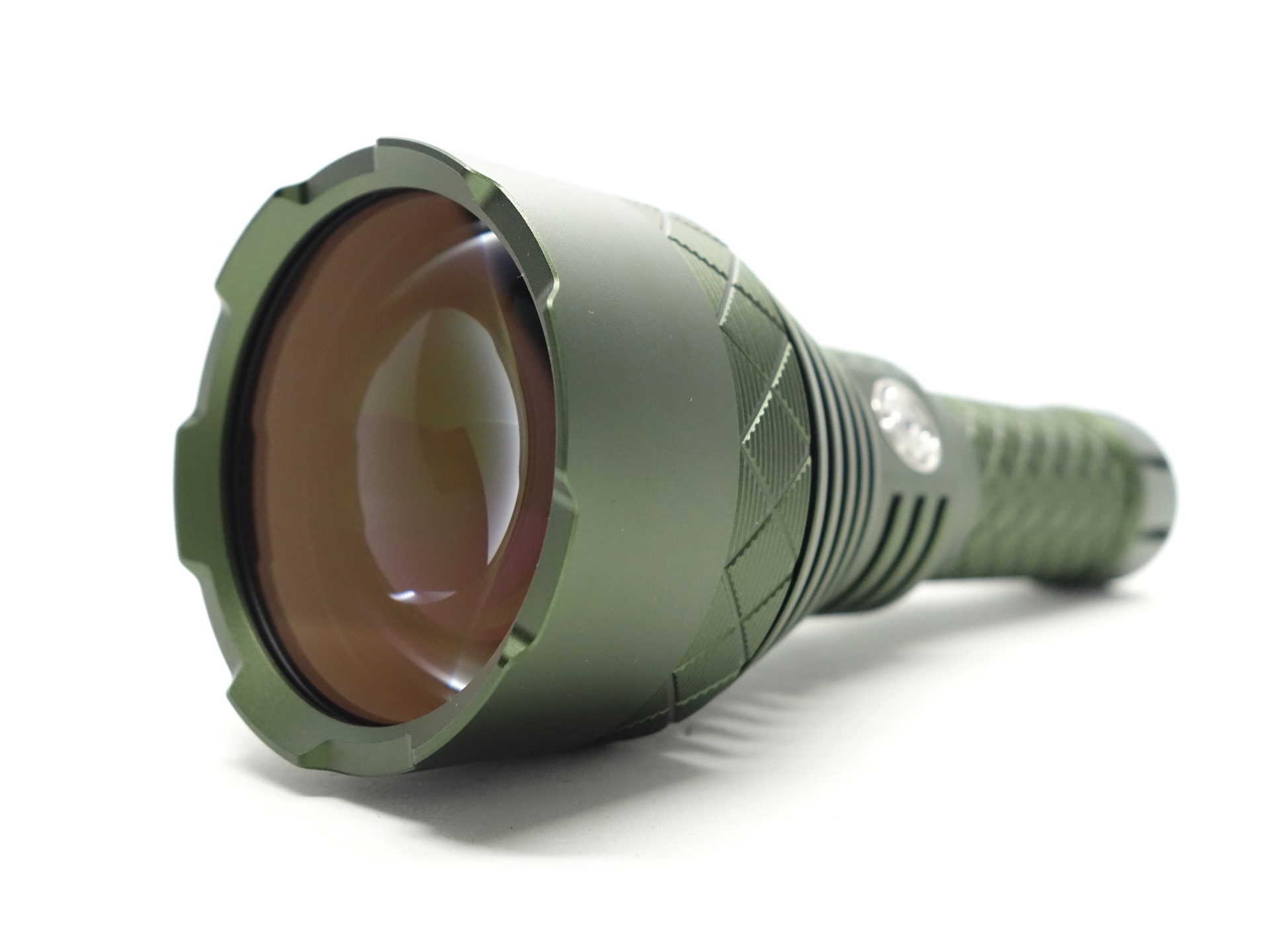
NLIGHTD L4 LEP Green#
- Specifications
- Introduction
- Torch in use
- Build quality
- LED, bezel, lens, reflector and beam
- Size and comparison
- User interface
- Batteries and charging
- Performance
- Beamshots
- Thermal Images
- Conclusion
- Price
- Product page
Specifications#
| Brand/model | NLIGHTD L4 |
|---|---|
| LEP | 15W shine-through LEP module |
| Maximum lumens | 900 lm |
| Maximum beam intensity | 1,563,000 cd |
| Maximum throw | 2,500 m |
| Battery | 1*21700 |
| Onboard charging | Yes (USB-C) |
| Material | Aluminium |
| Modes | 2 |
| Blinkies | |
| Waterproof | IPX8 |
| Review date | August 2026 |
Introduction#
The NLIGHTD L4 is a 21700-sized torch with a 15W shine-through Laser Excited Phosphor (LEP) module, a large lens, and USB-C charging.
I recently tested the NLIGHTD L4 Prototype and provided feedback. Neal then sent the final version for review.
This was going to be a relatively quick follow-up of the NLIGHTD L4 Prototype review but it has become another comprehensive review.
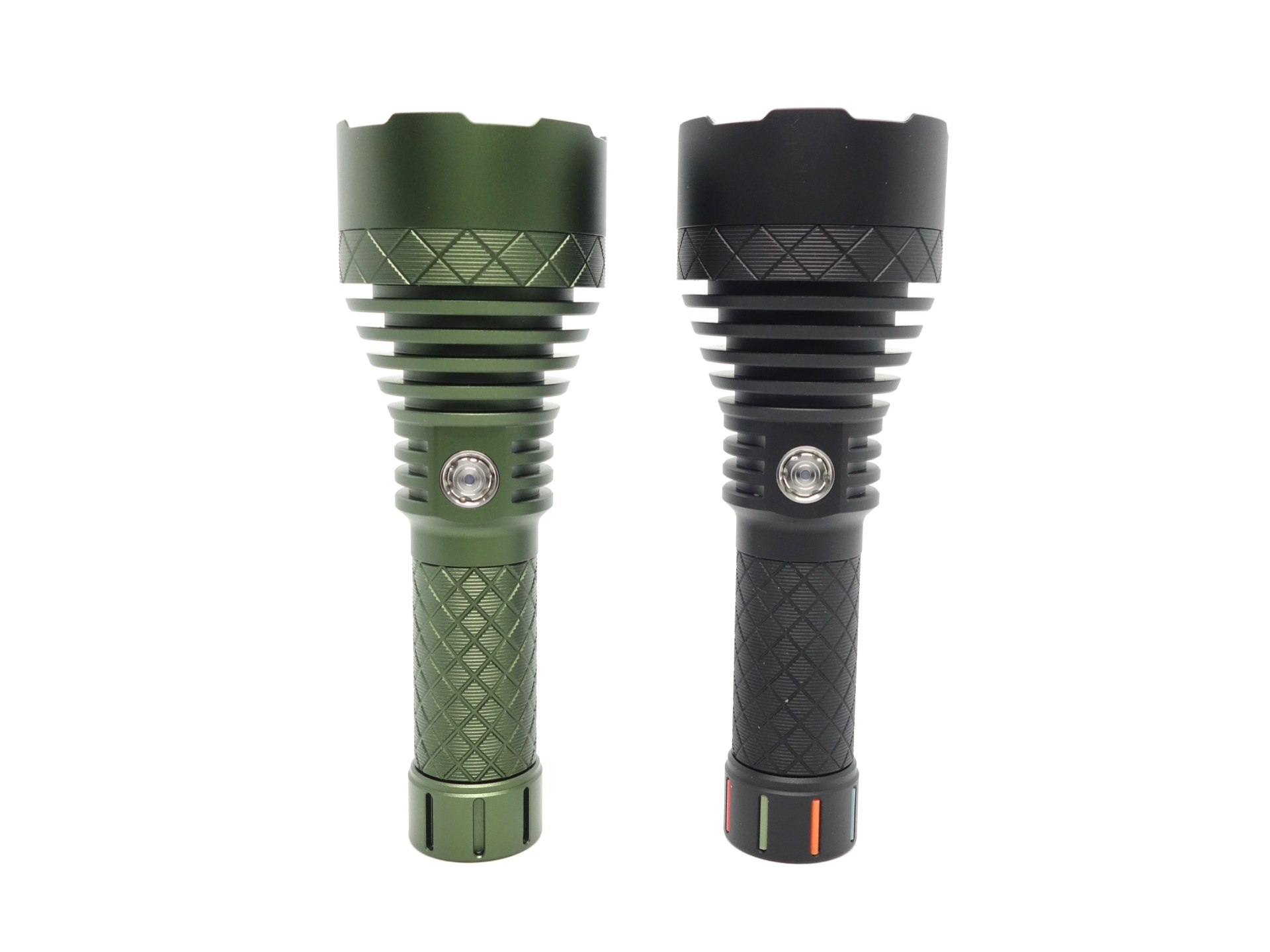
Here are some of the changes between the prototype and the final version:
- The beam distance has improved. I measured over 2,800 metres.
- The runtime for High is slightly longer before step down.
- The lumen output has doubled for Low and the runtime has been reduced.
- The positive terminal has a plastic circle shielding the electronic components behind it.
- The user interface is simpler. It has High, Low and Lock modes. No mode memory. Defaults to High.
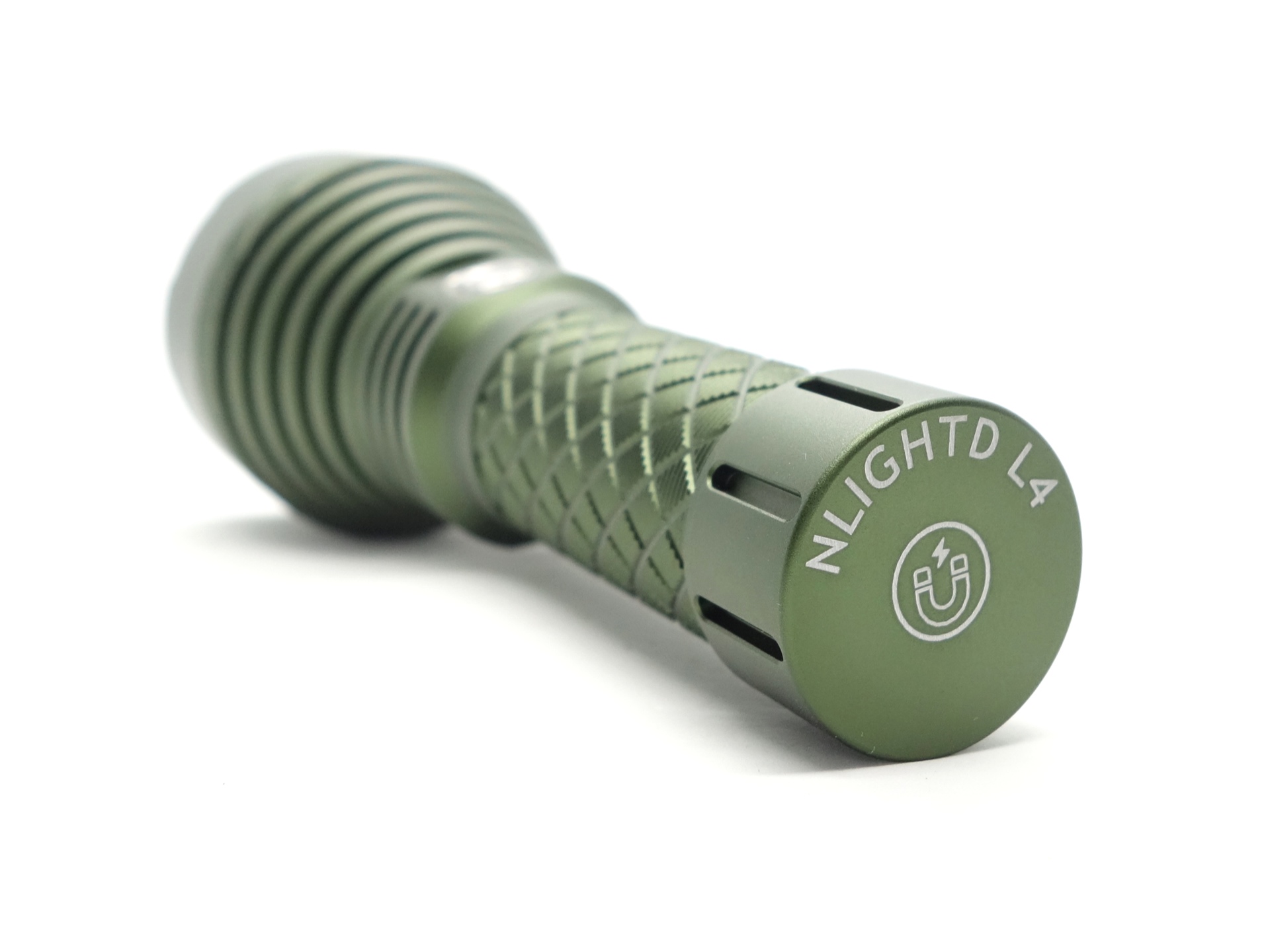
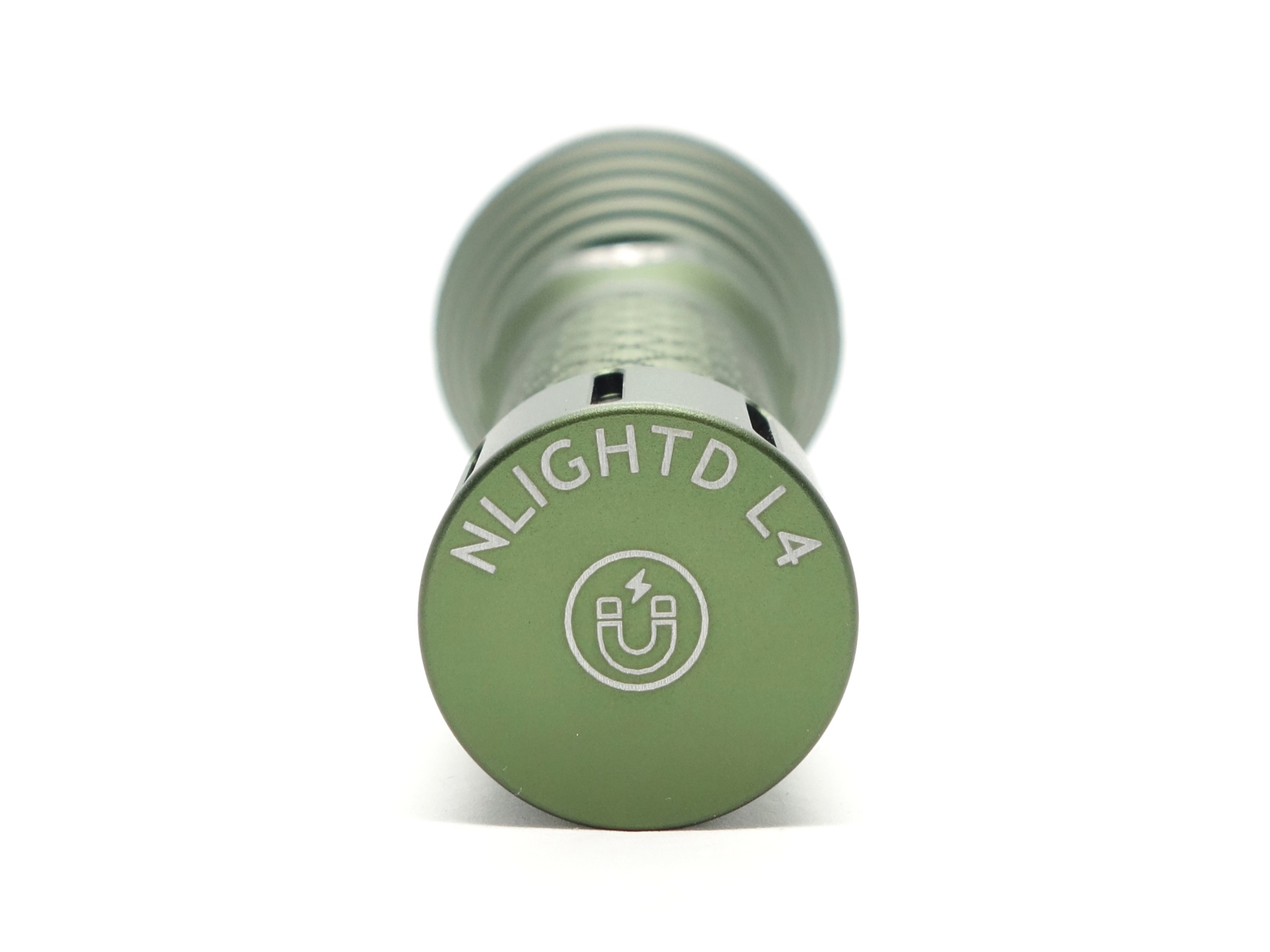
- NLIGHTD L4 and a magnet symbol are laser etched on the tailcap.
- Green glow sticks were provided with this green version of the NLIGHTD L4.
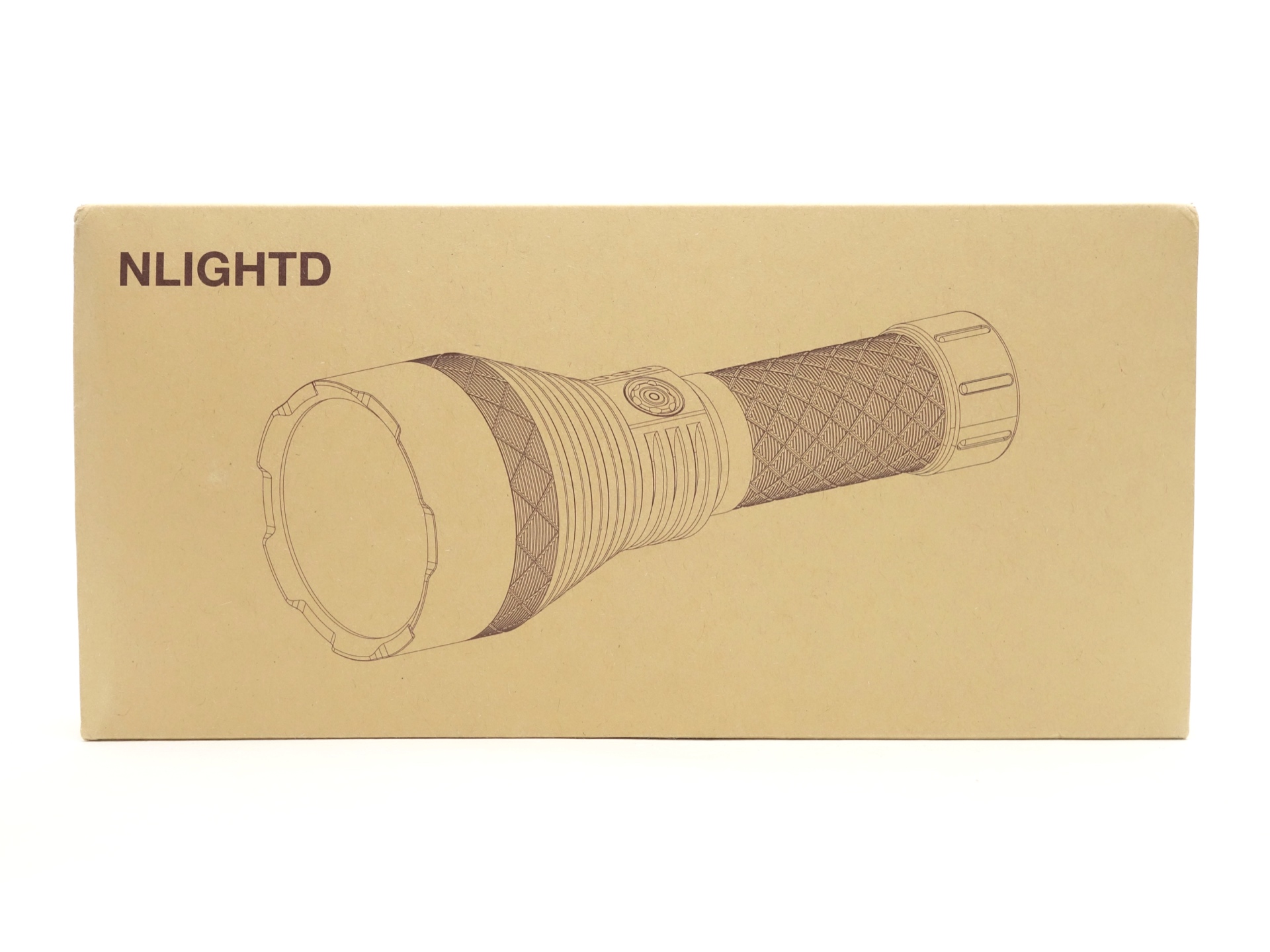
- The torch came in NLIGHTD branded packaging.
From left to right: NLIGHTD L4 Green, NLIGHTD L4 Prototype
NLIGHTD is a brand by nealsgadgets.com.
Neal kindly provided this torch for review. I have not been paid for this review nor have I held back my opinions of this torch.
Packaging#
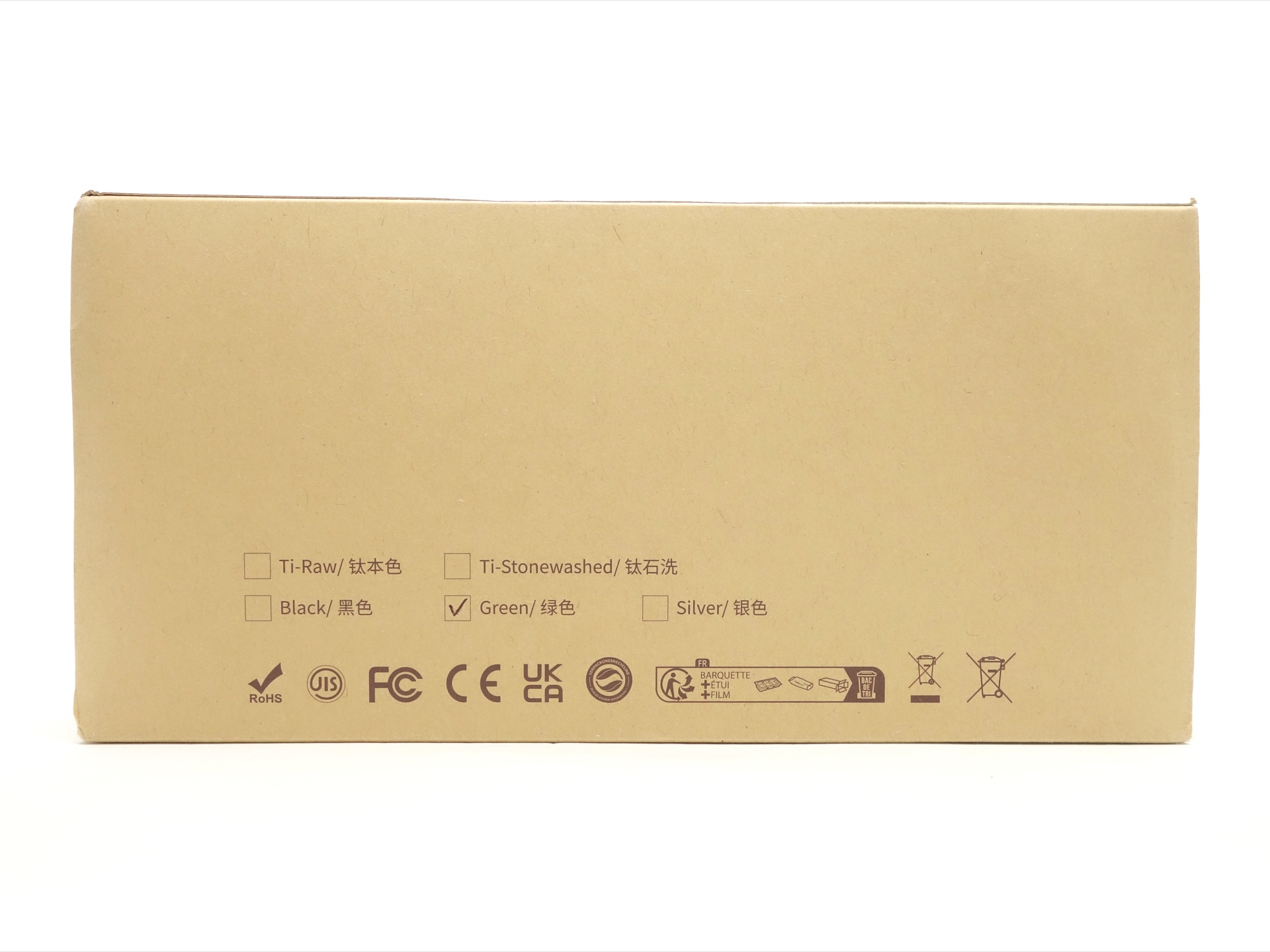
The NLIGHTD L4 comes in a simple cardboard box with a sheath. An image of the torch is on the top.
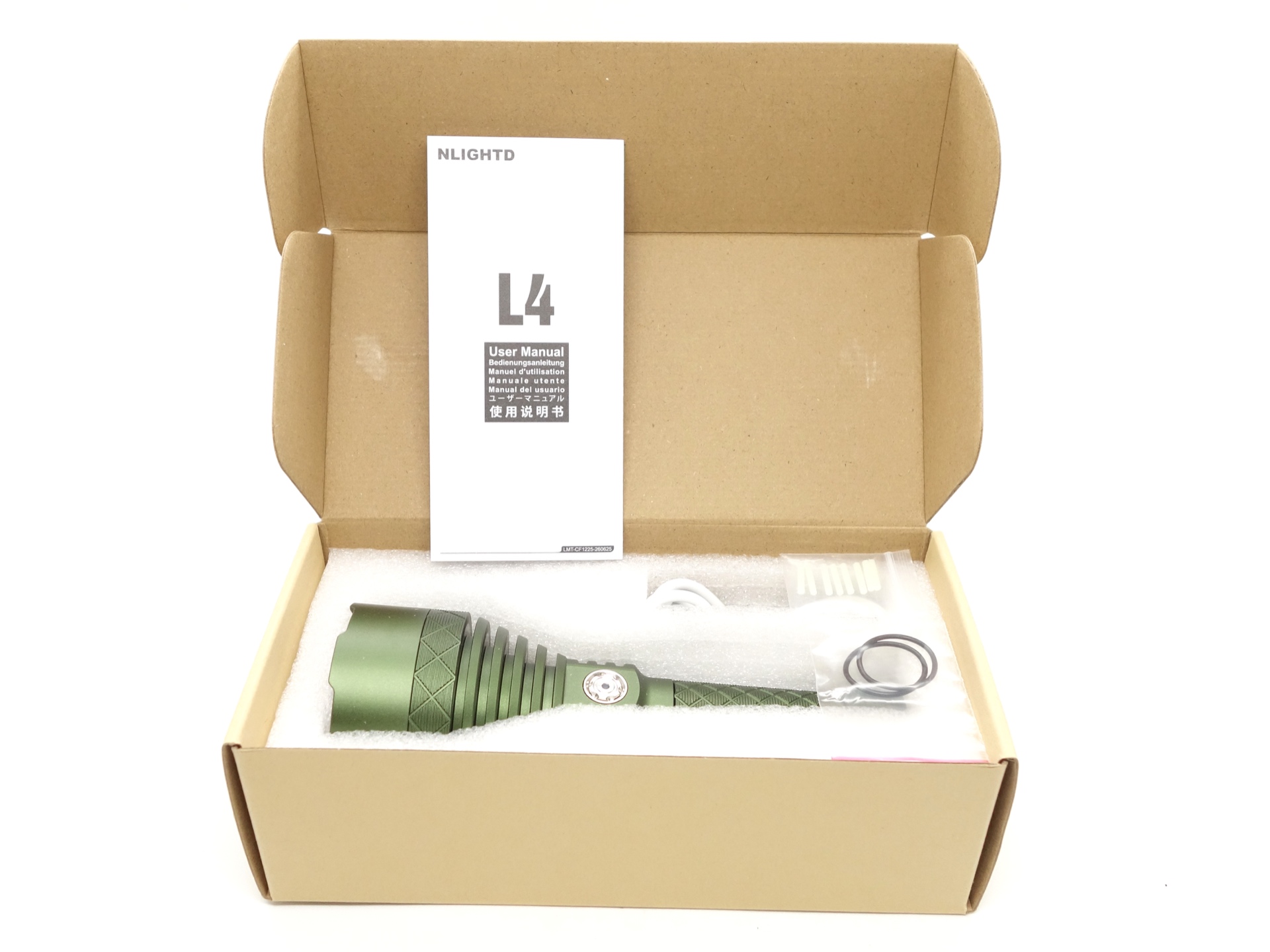
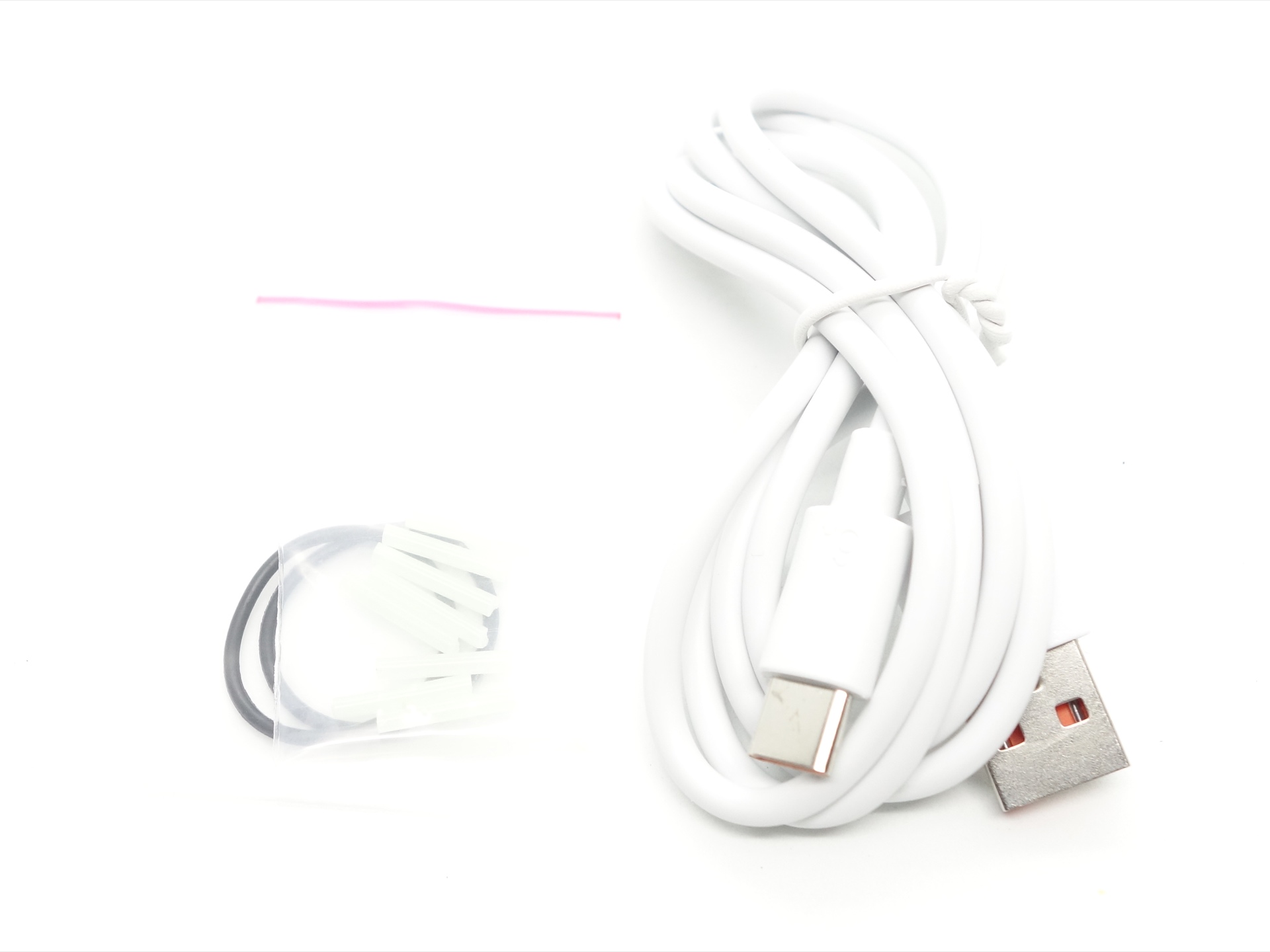
The following is included in the box:
- NLIGHTD L4 Green
- NLIGHTD 21700 3.6V Li-ion 6500mAh
- Two spare o-rings
- USB-A to USB-C charging cable
- Eight green glow sticks (optional)
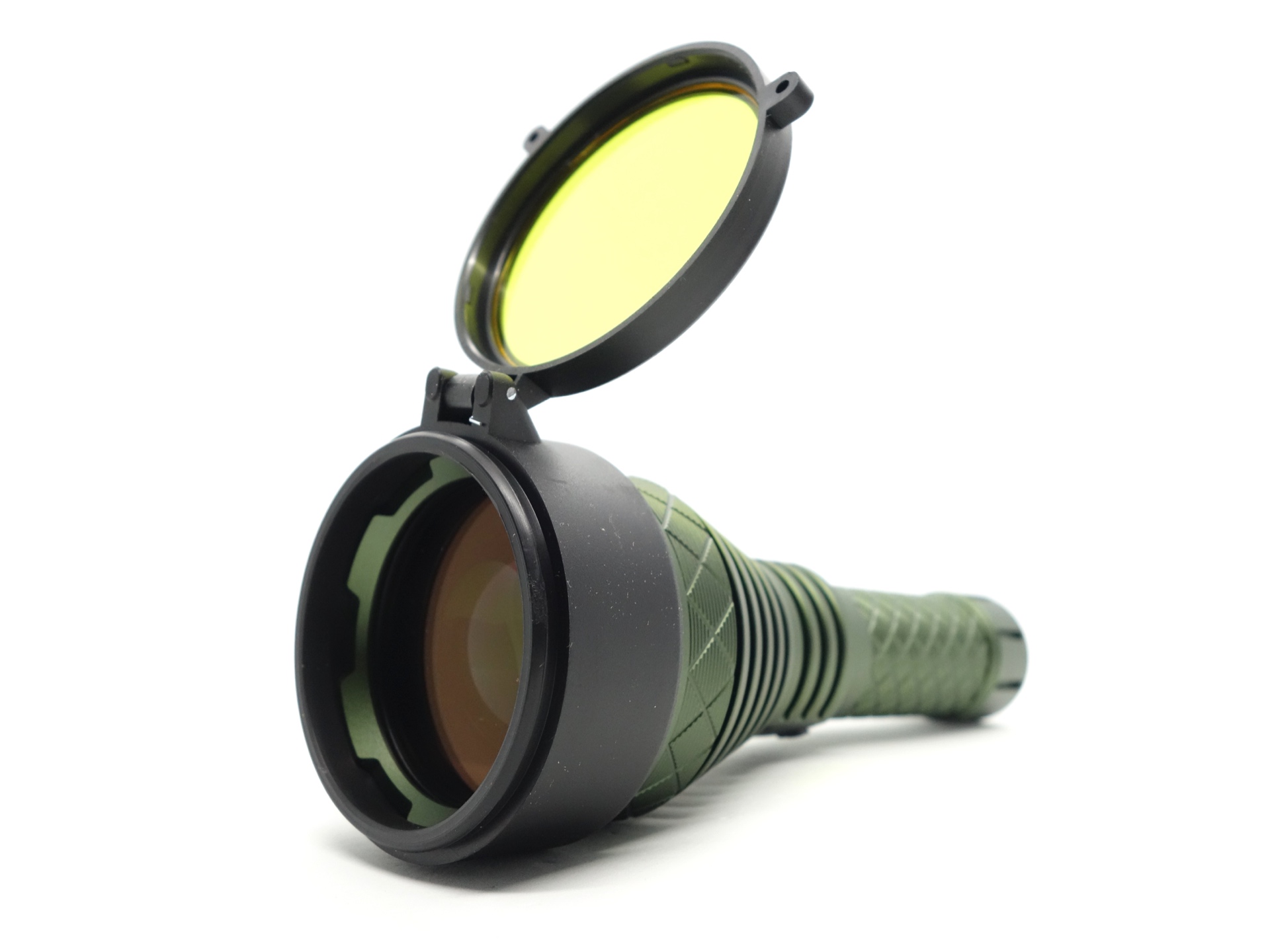
- Yellow filter (optional)
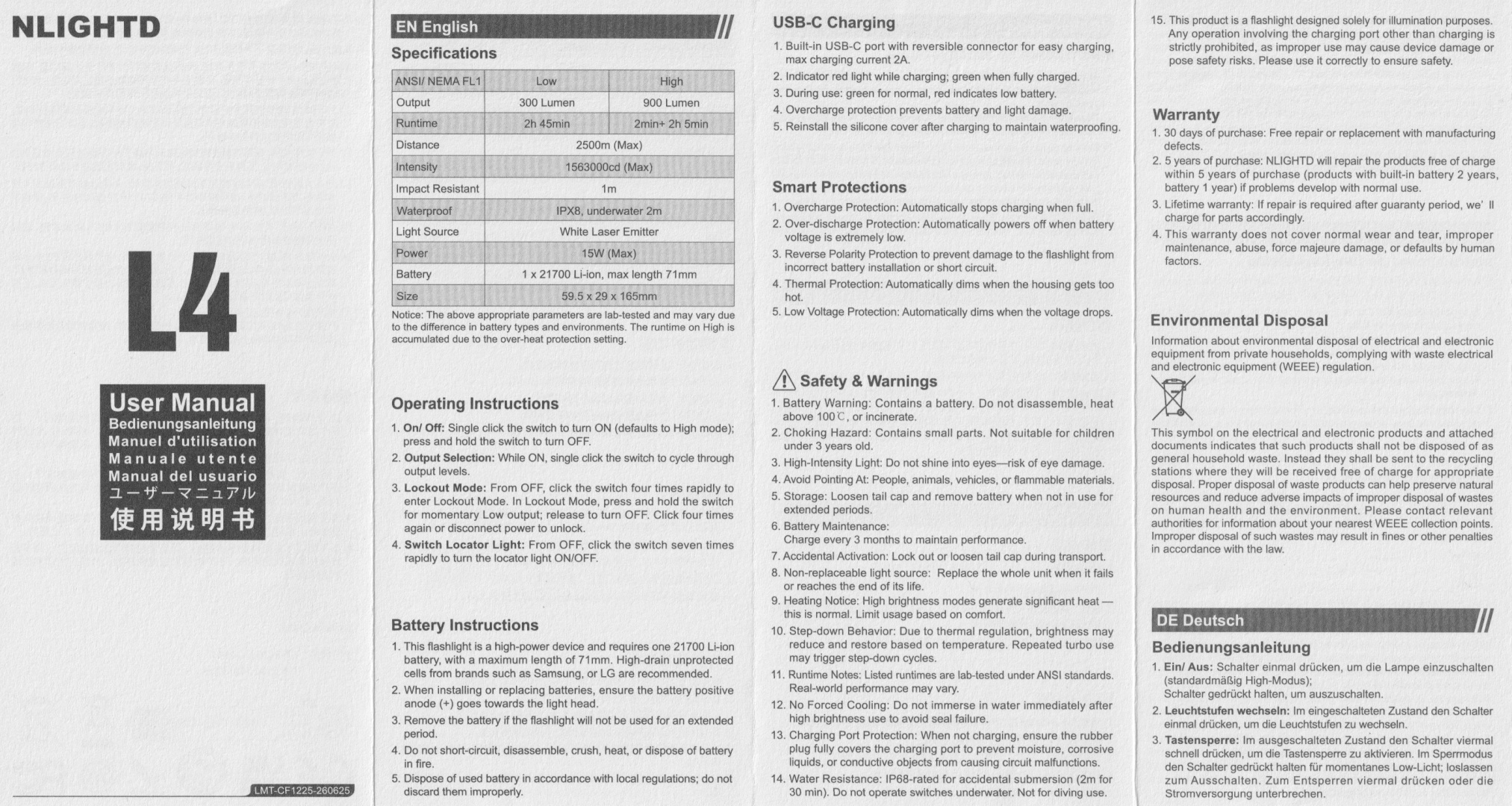
- User manual
User manual#
Torch in use#
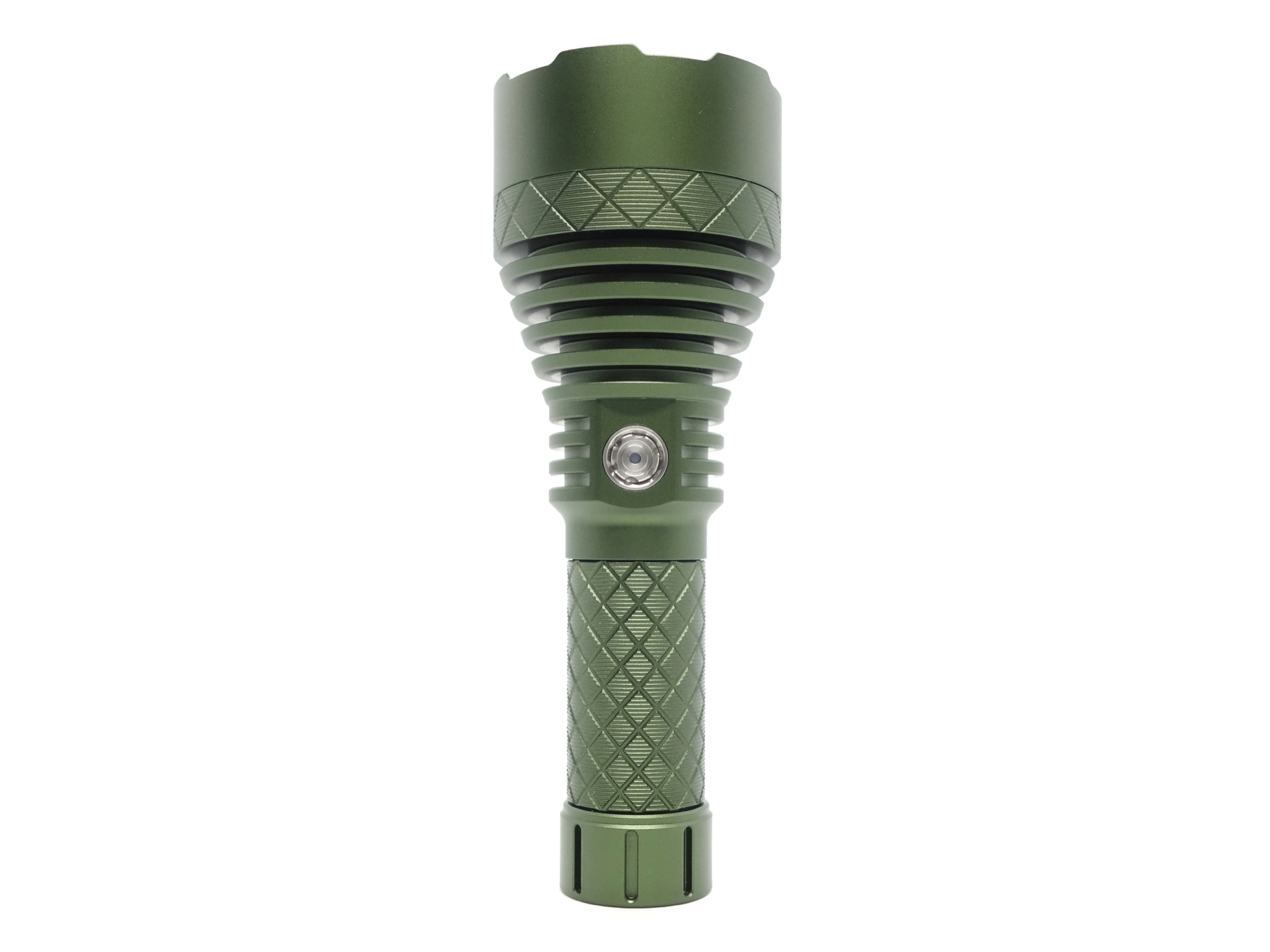
The torch is comfortable to hold.
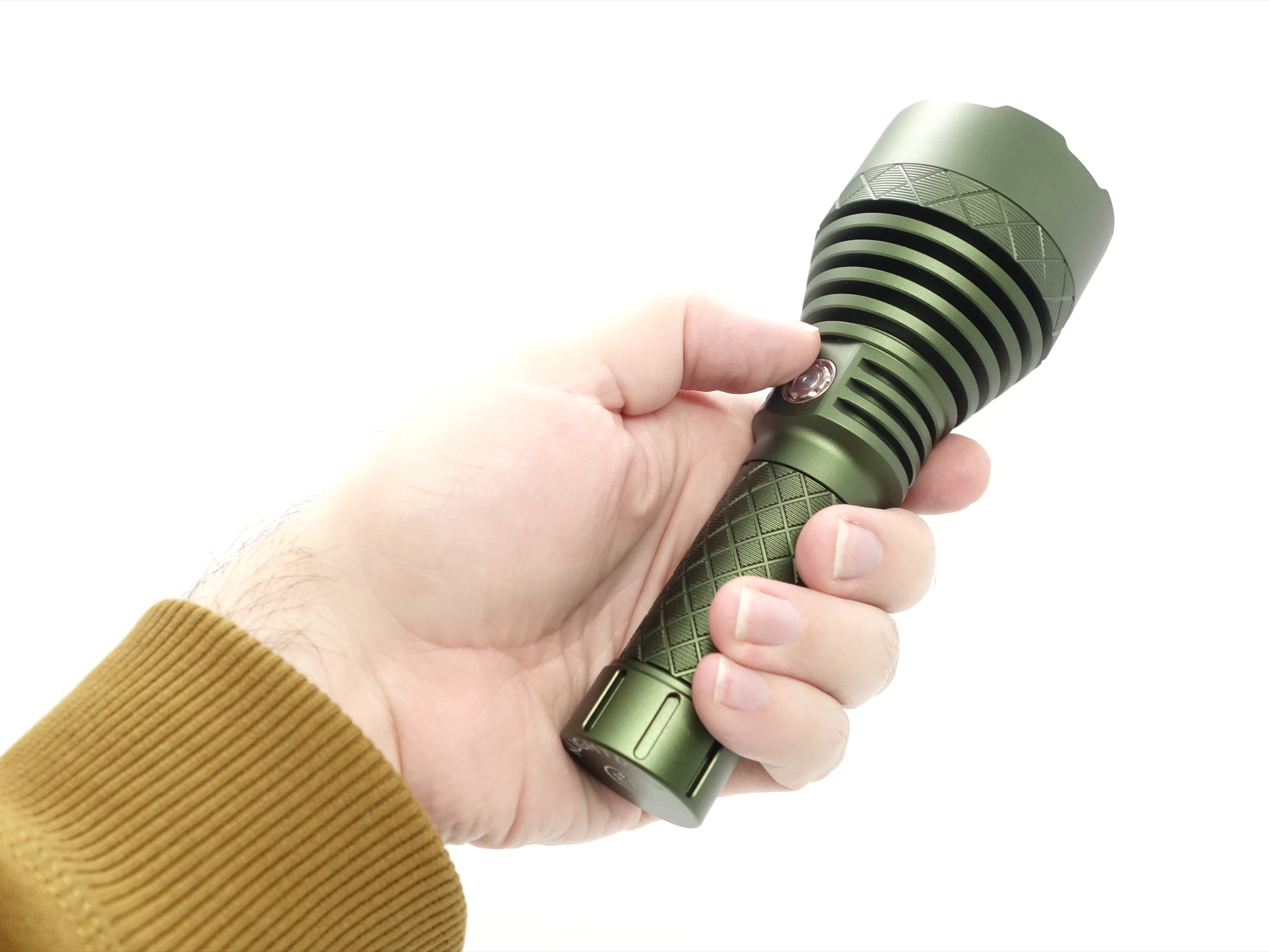
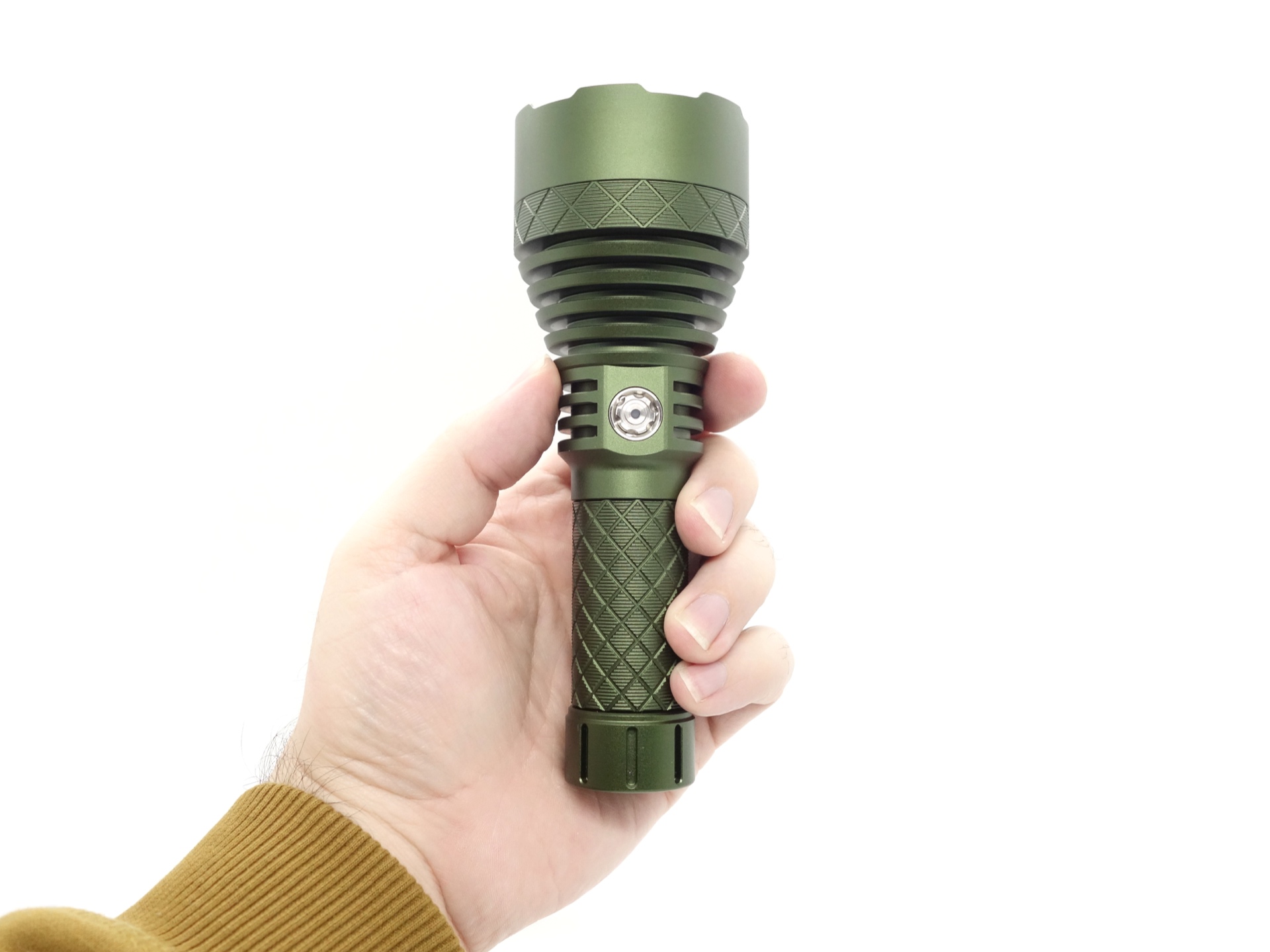
It is slightly top heavy.
The torch is controlled by a side switch with a battery status indicator light in the centre.
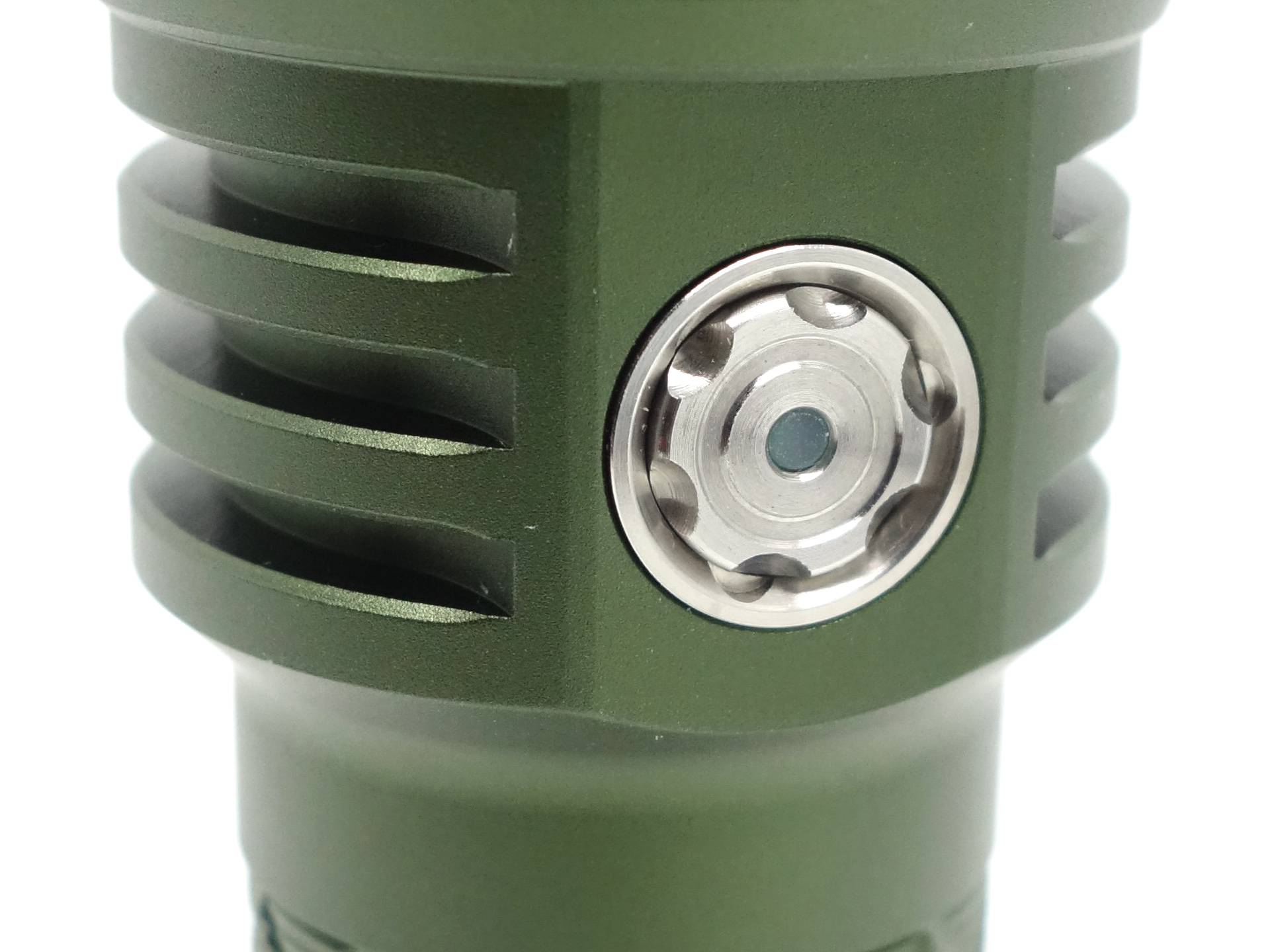
The torch can tailstand.
There is no lanyard hole.
The strong magnet in the tailcap makes it easy to remove the battery.
Like most LEP torches, this type of torch is intended for looking at things hundreds or thousands of metres away. It is not suitable for lighting up a path to see where you are walking because the hot spot is too bright.
Build quality#
This NLIGHTD L4 is made of aluminium and it has a matte green anodised finish. There are no sharp edges.
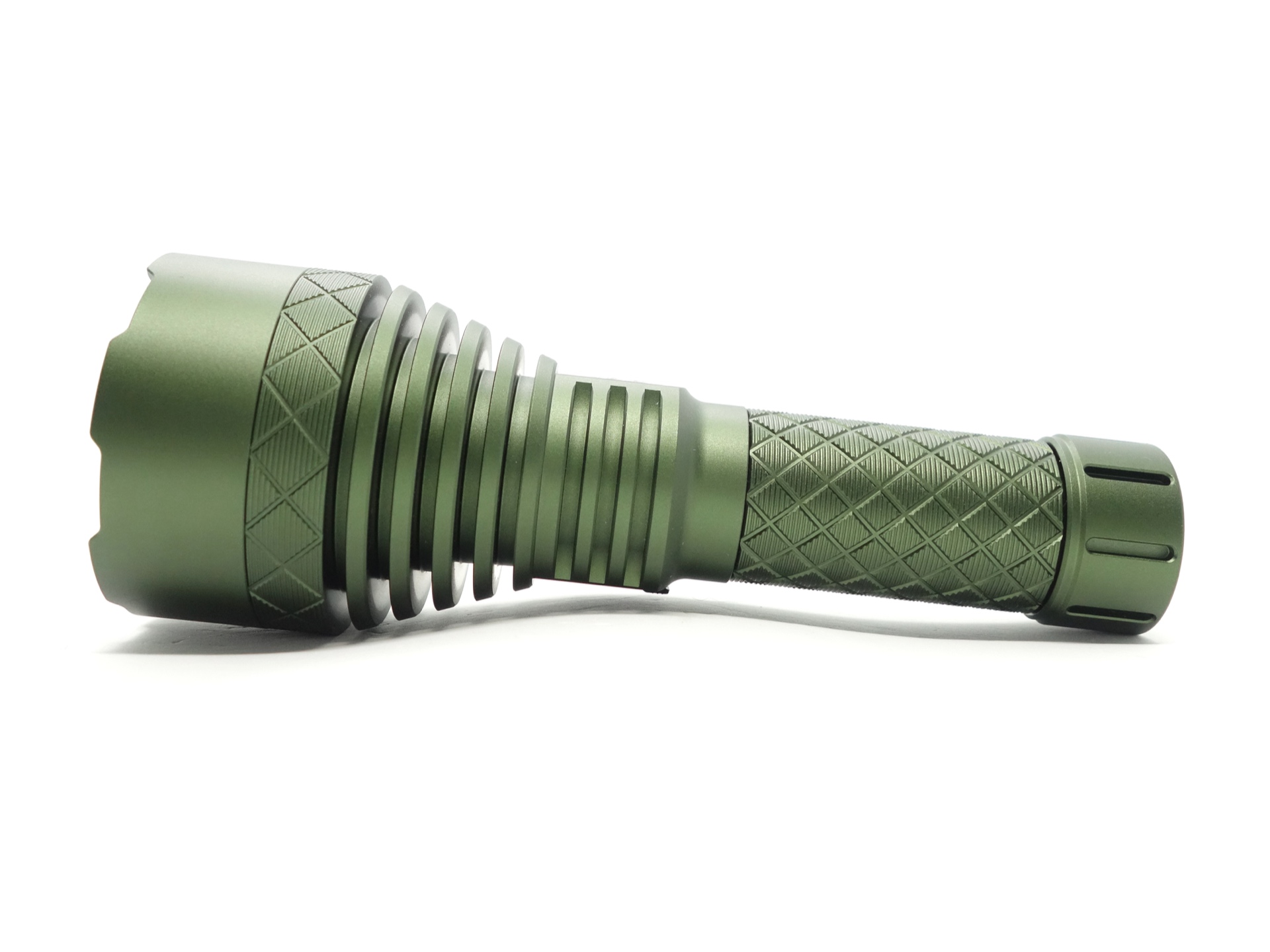
There is plenty of grip from the knurling on the tube. The heatsink fins near the LEP module have been chamfered.
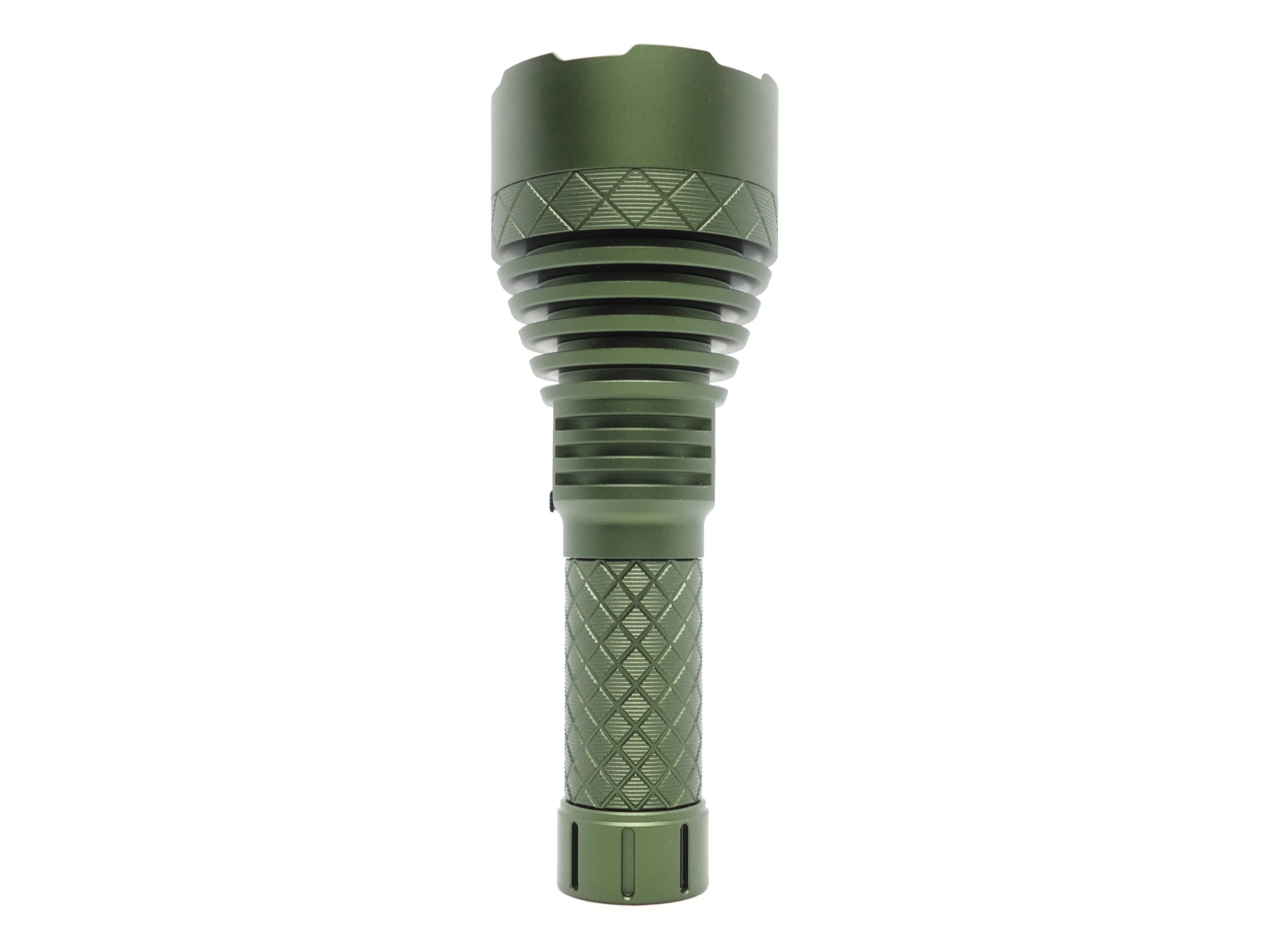
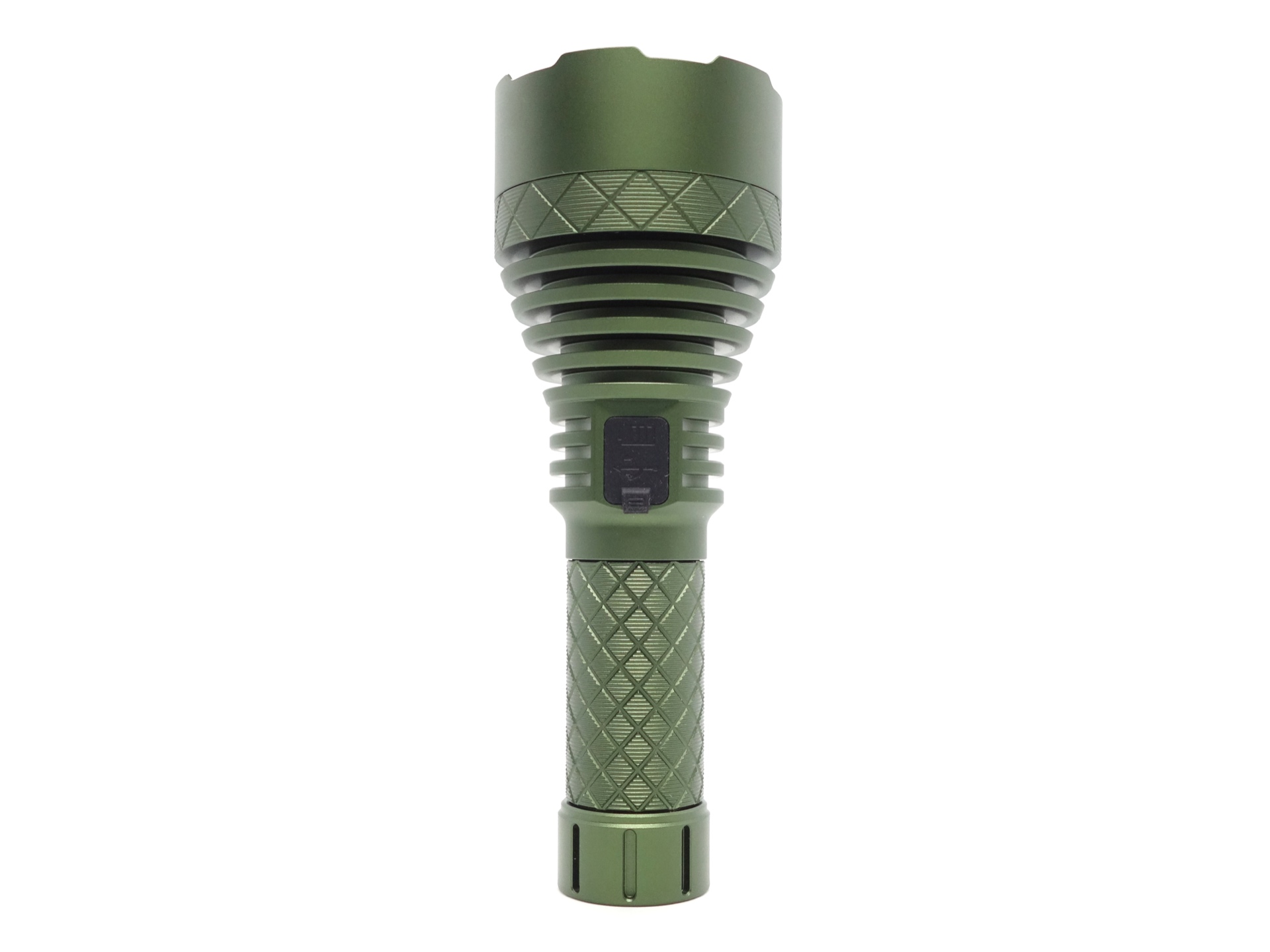
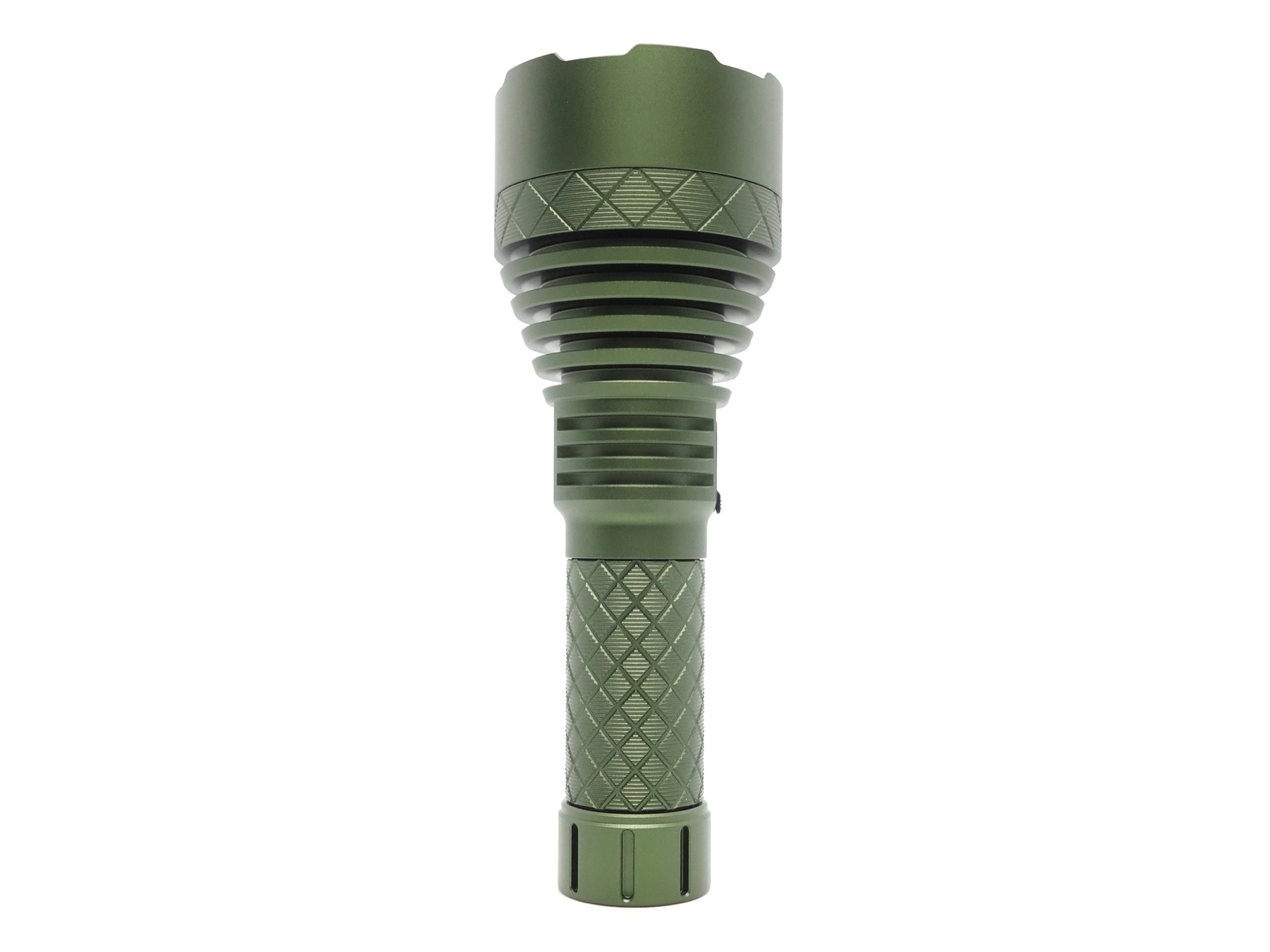
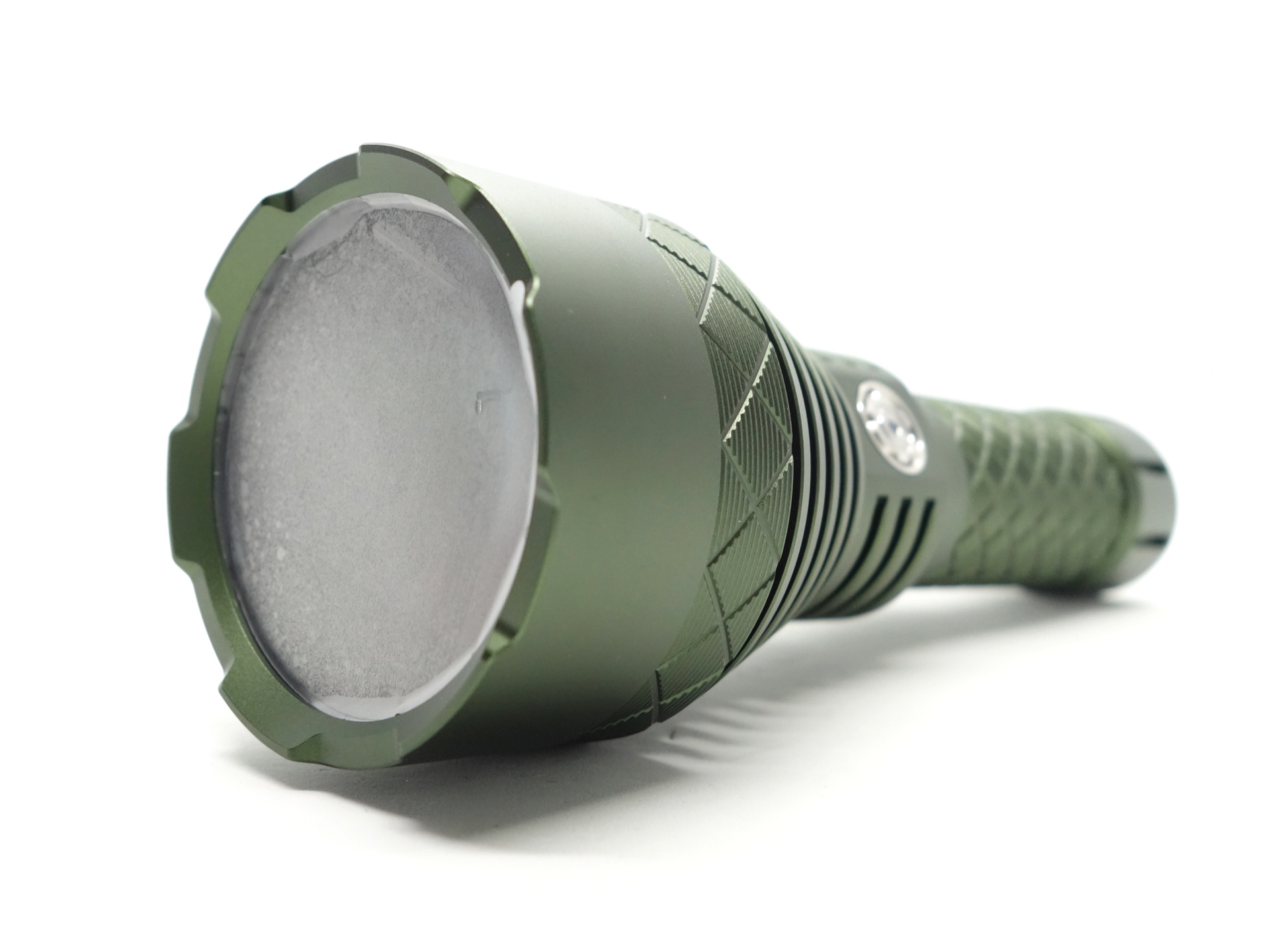
The torch arrived with a piece of plastic protecting the lens.
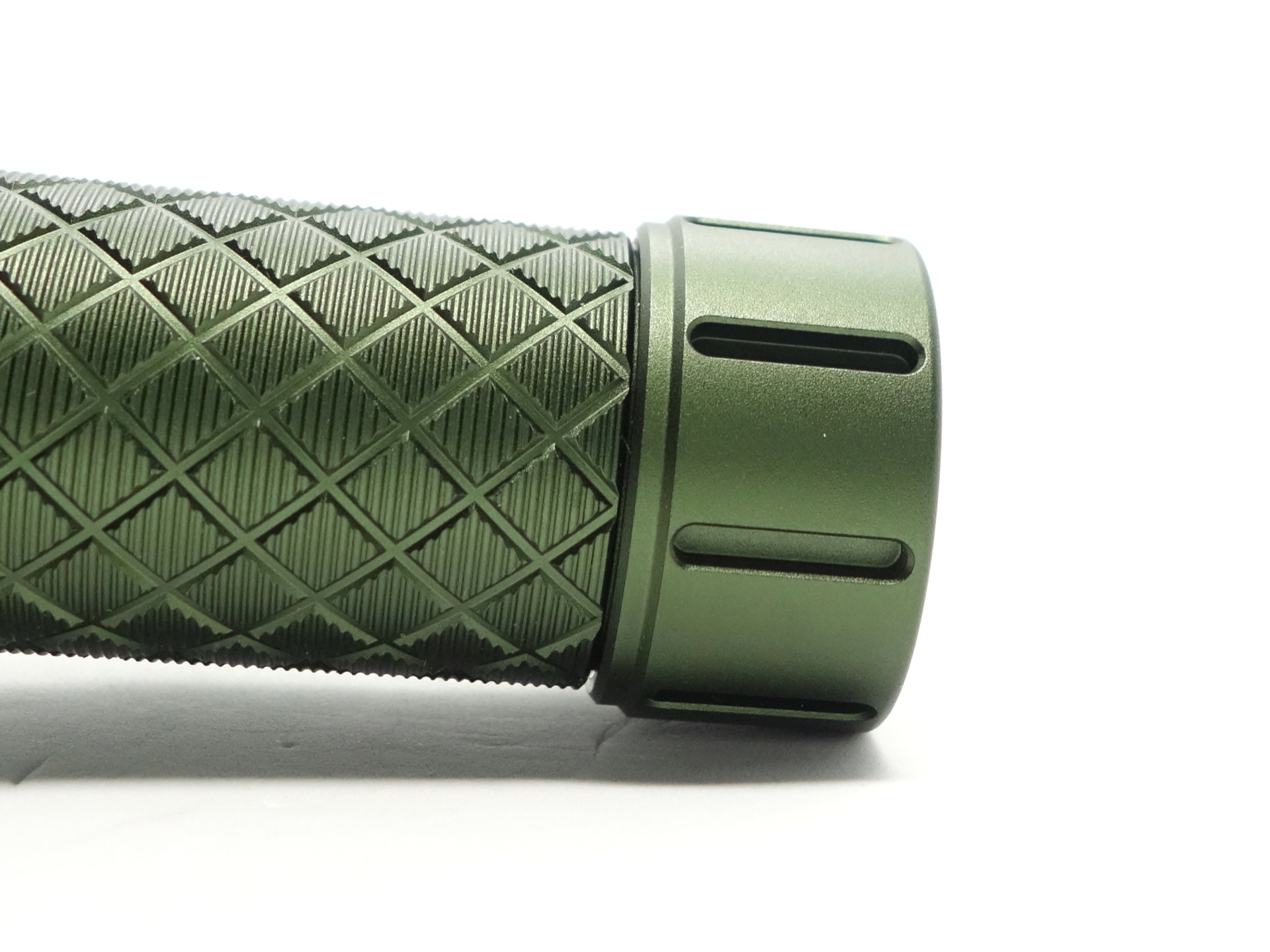
There are slots in the tailcap for glow sticks or tritium vials.
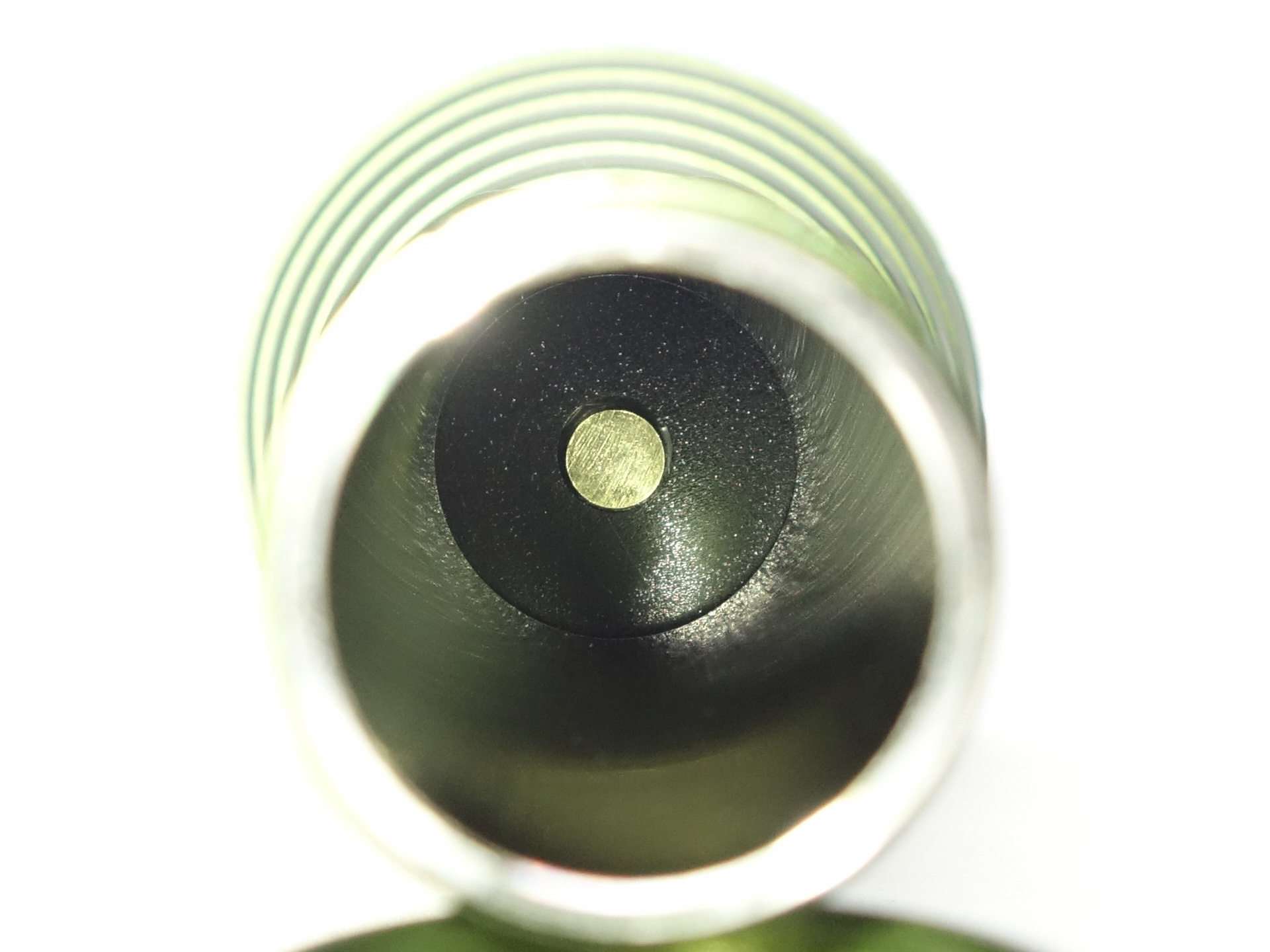
The head has a thick notch for the positive terminal surrounded by a plastic circle to shield the components. Flat top 21700 cells fit but longer button top protected cells are too long.
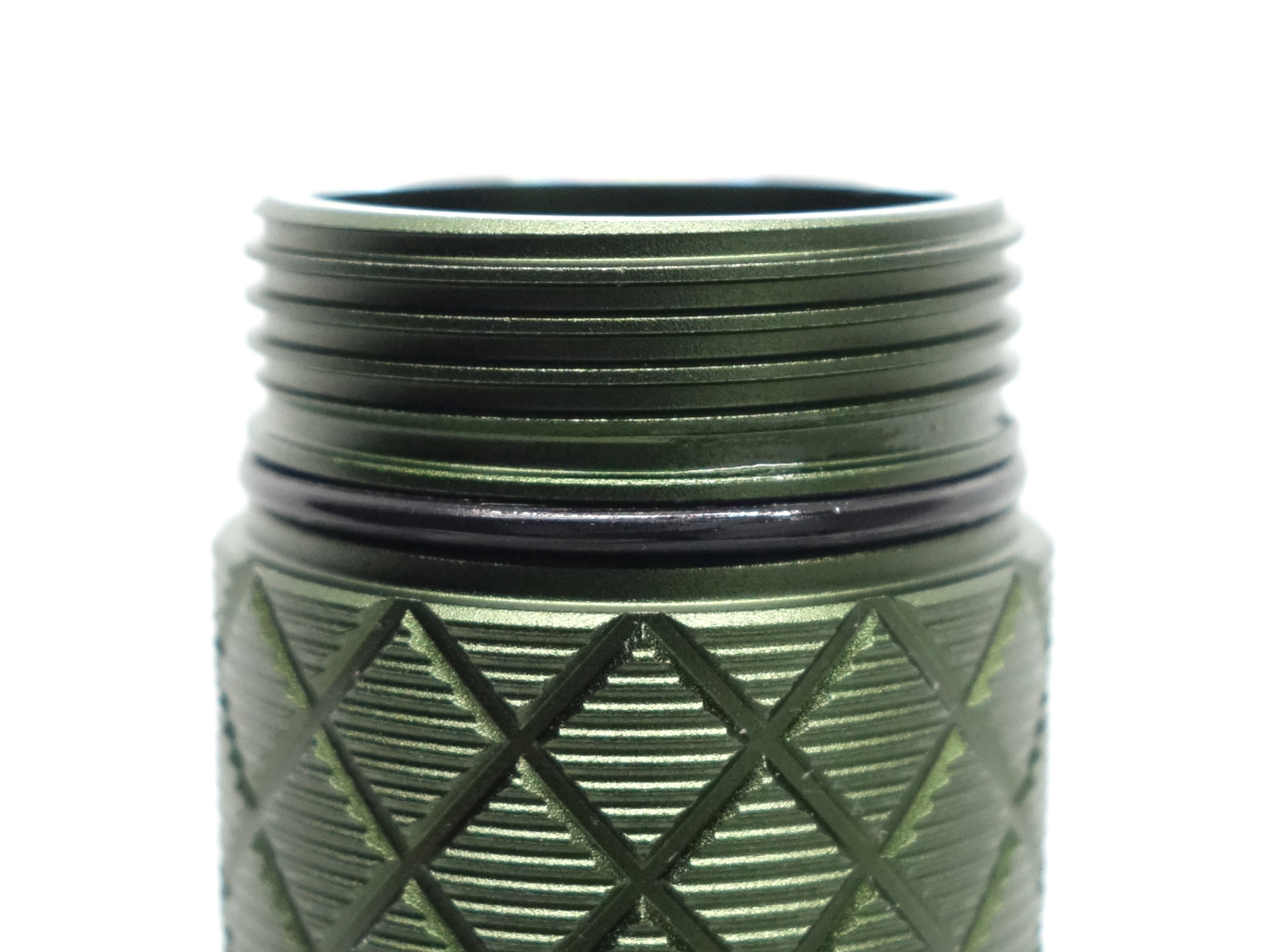
The tail threads are anodised and they turn smoothly. This allows you to physically disconnect the battery by slightly unscrewing the tailcap.
The inside of the tube is also anodised.
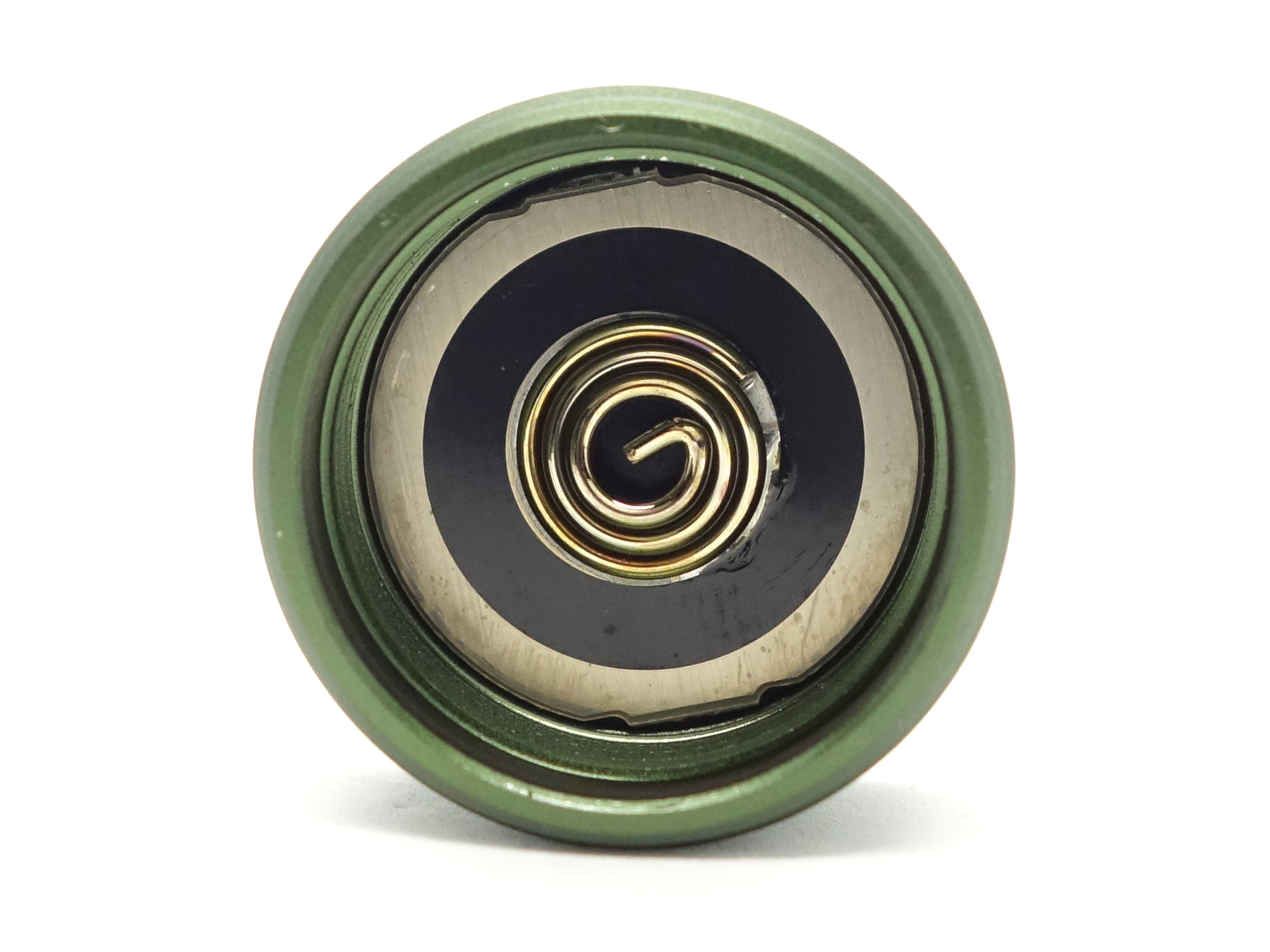
The build quality is really nice.
LED, bezel, lens, reflector and beam#
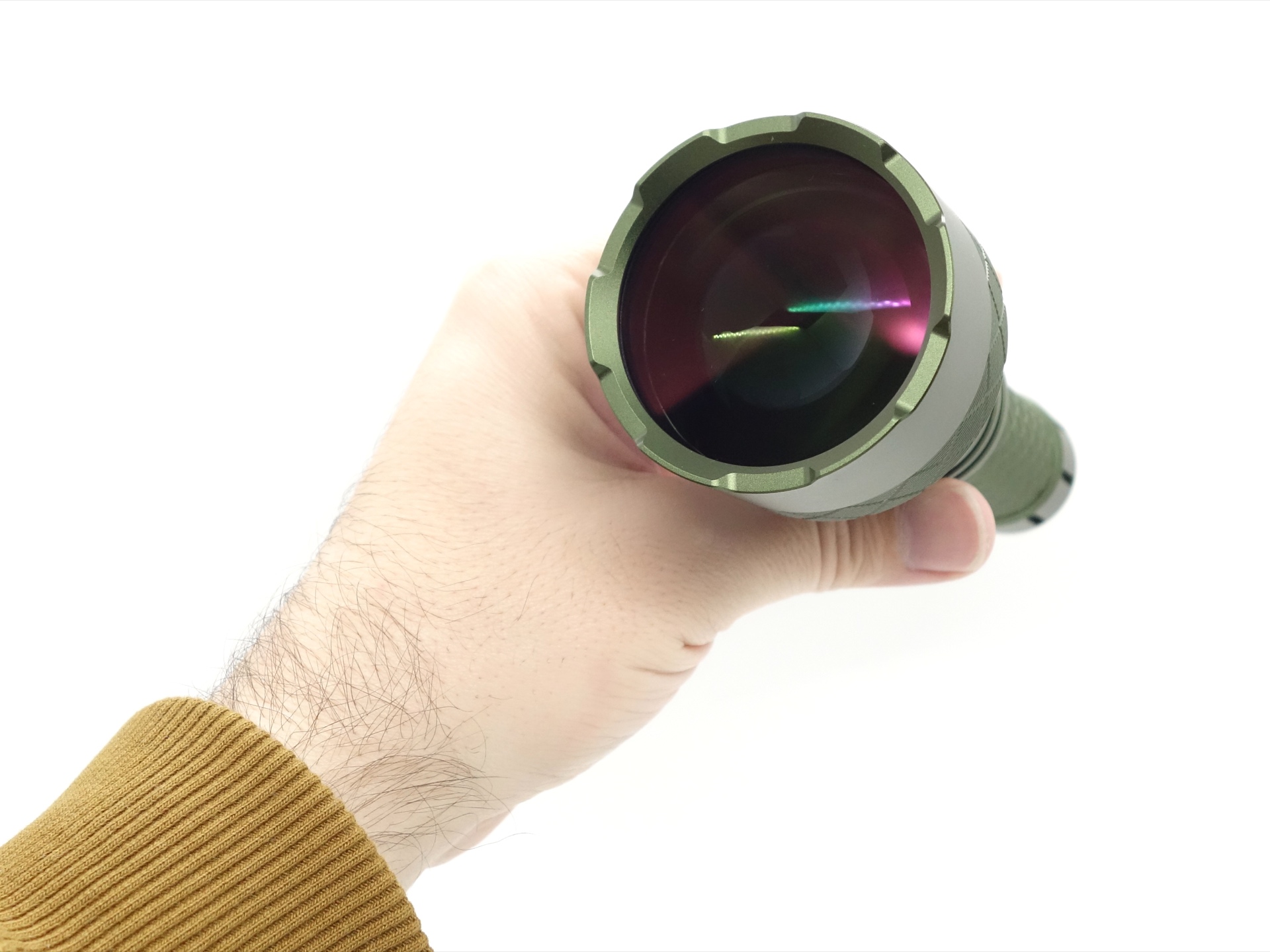
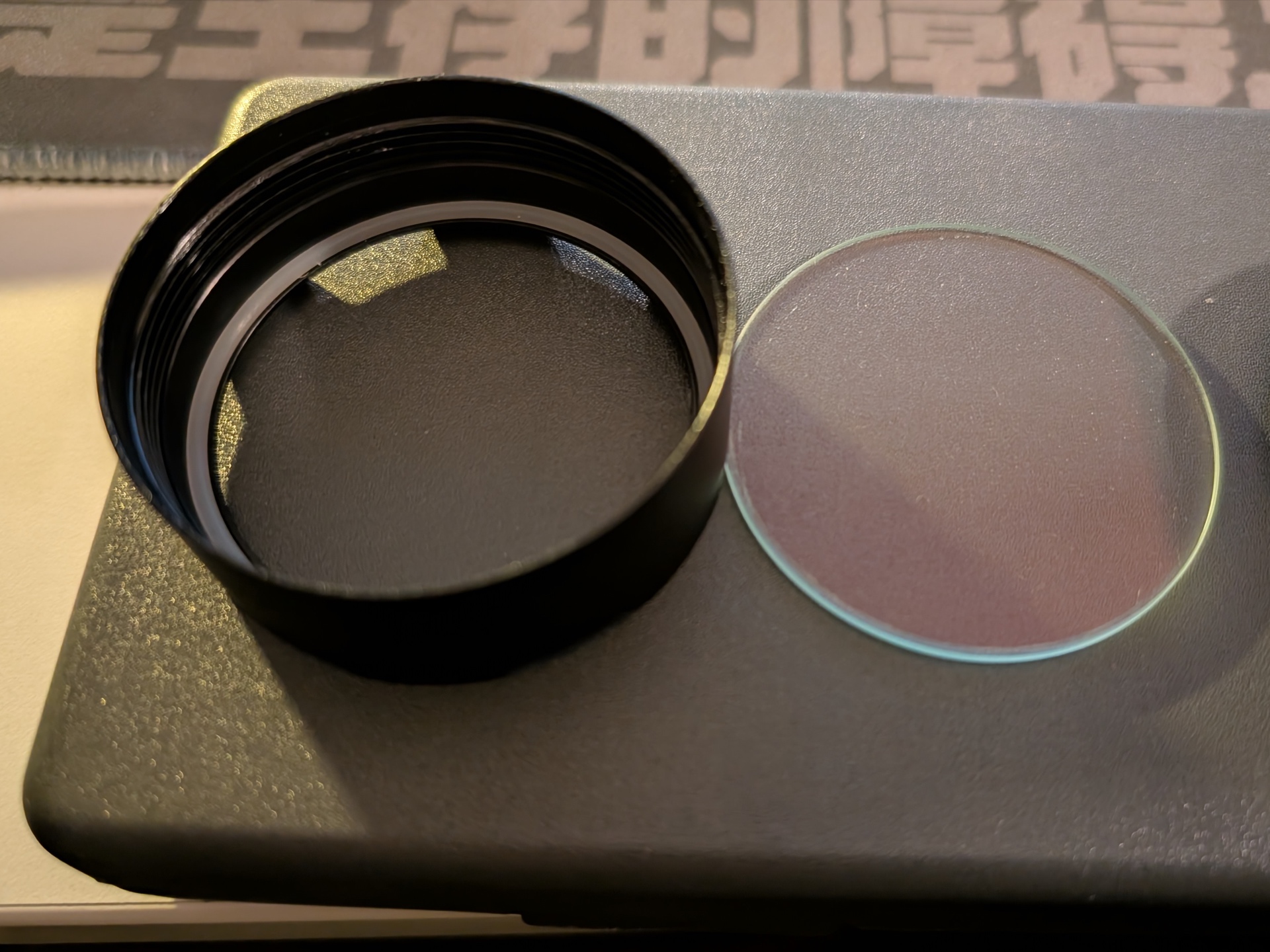
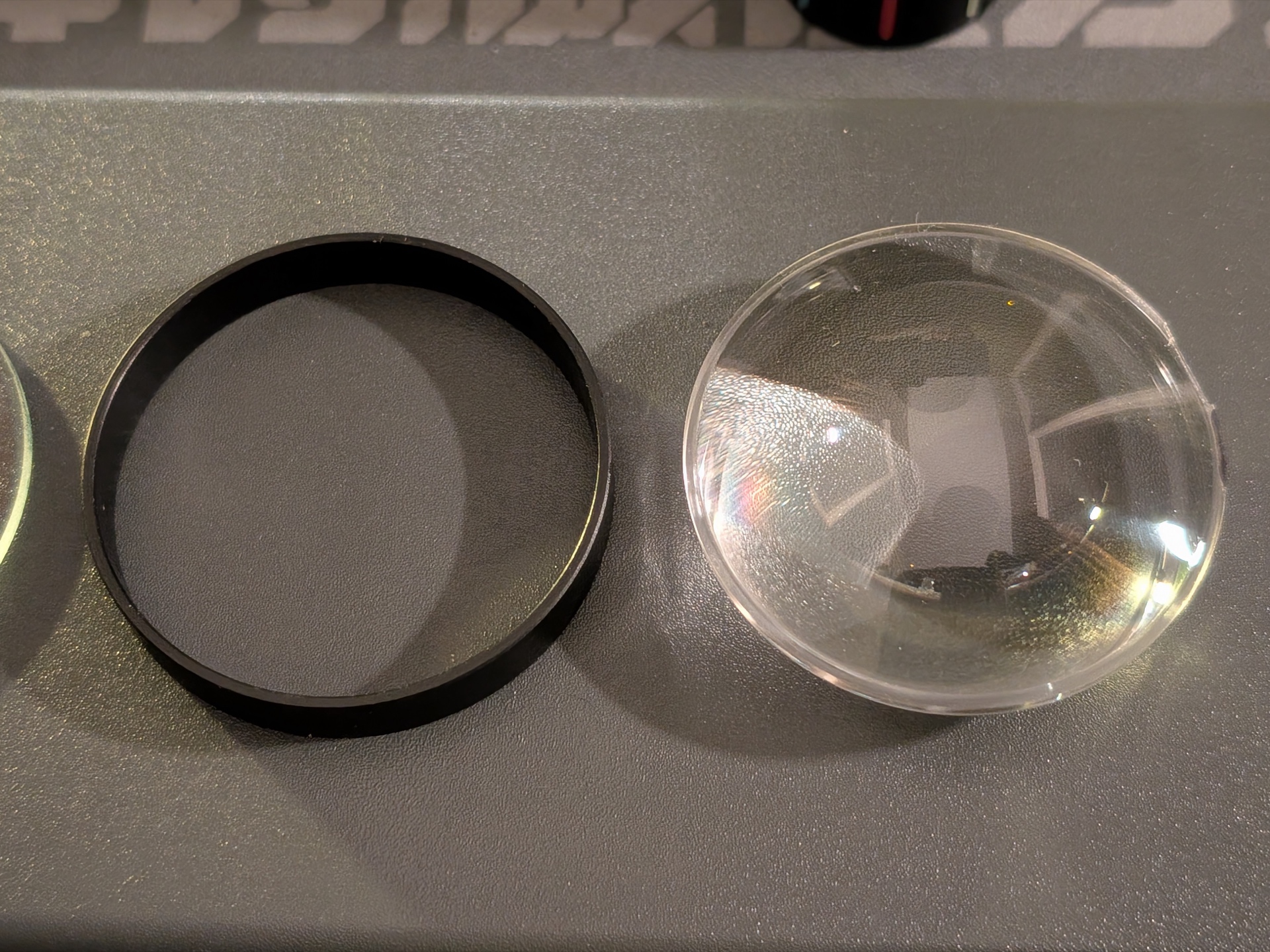
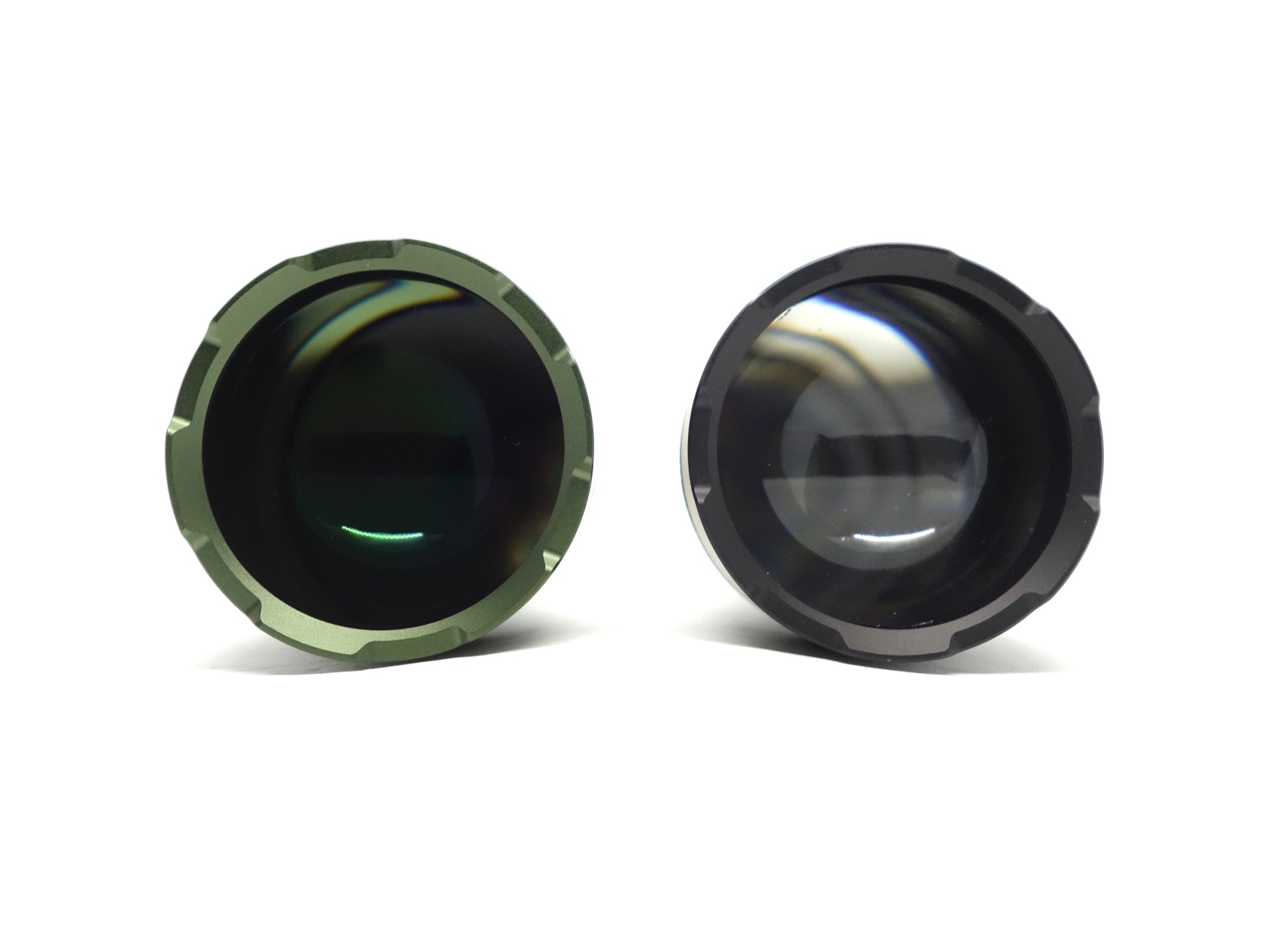
The NLIGHTD L4 has a 15W shine-through LEP module behind a 54.6mm biconvex lens.
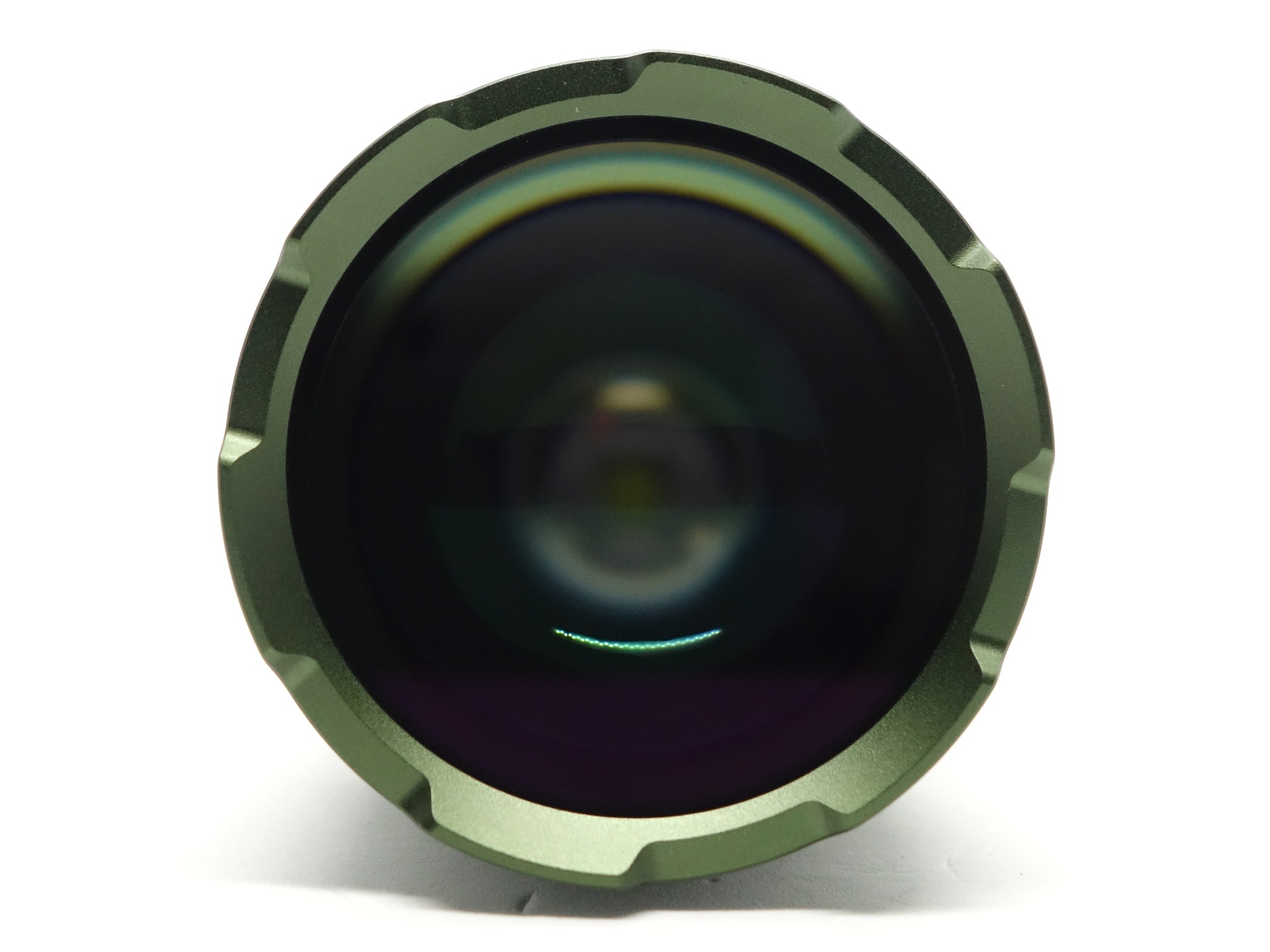
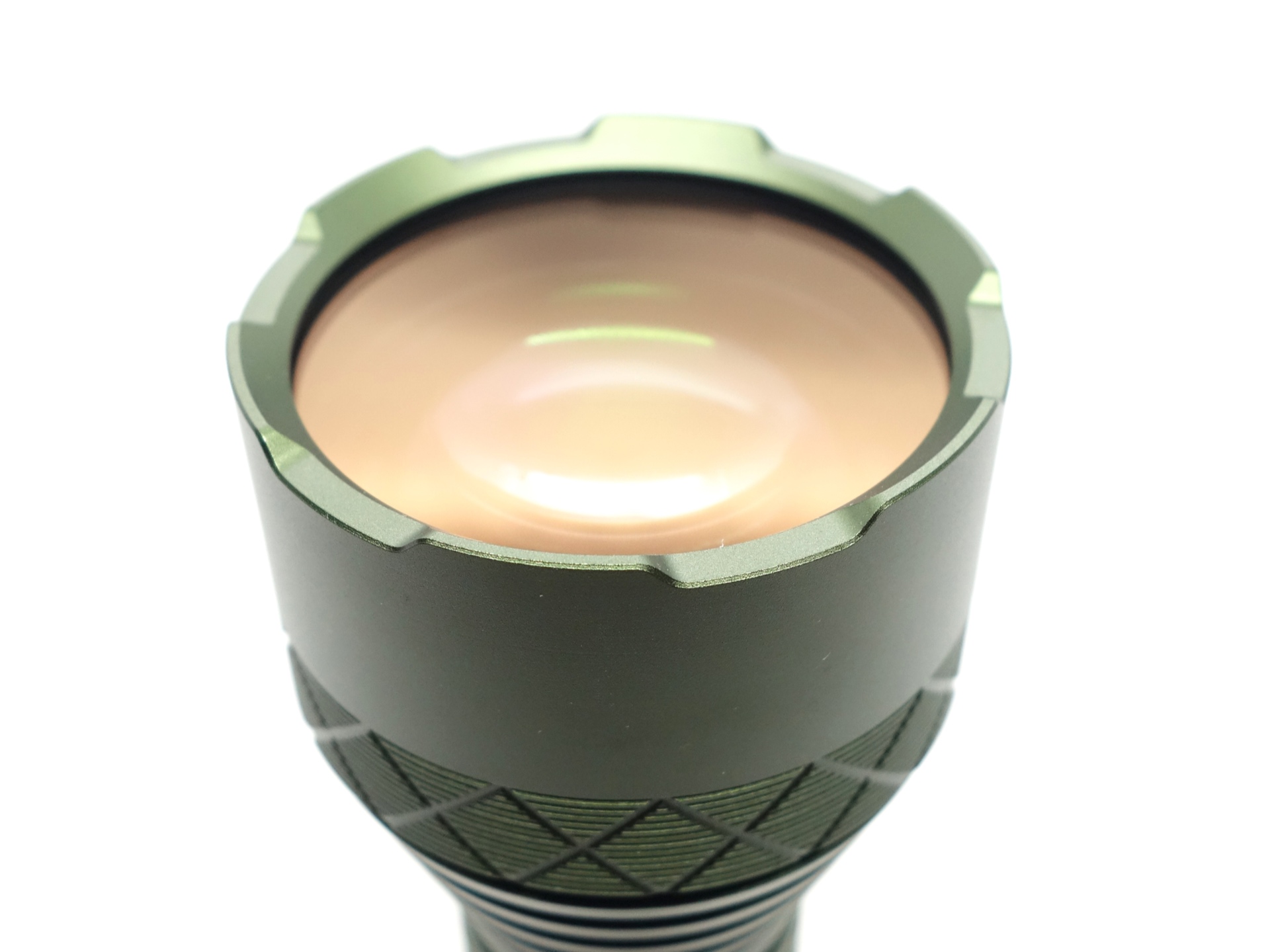
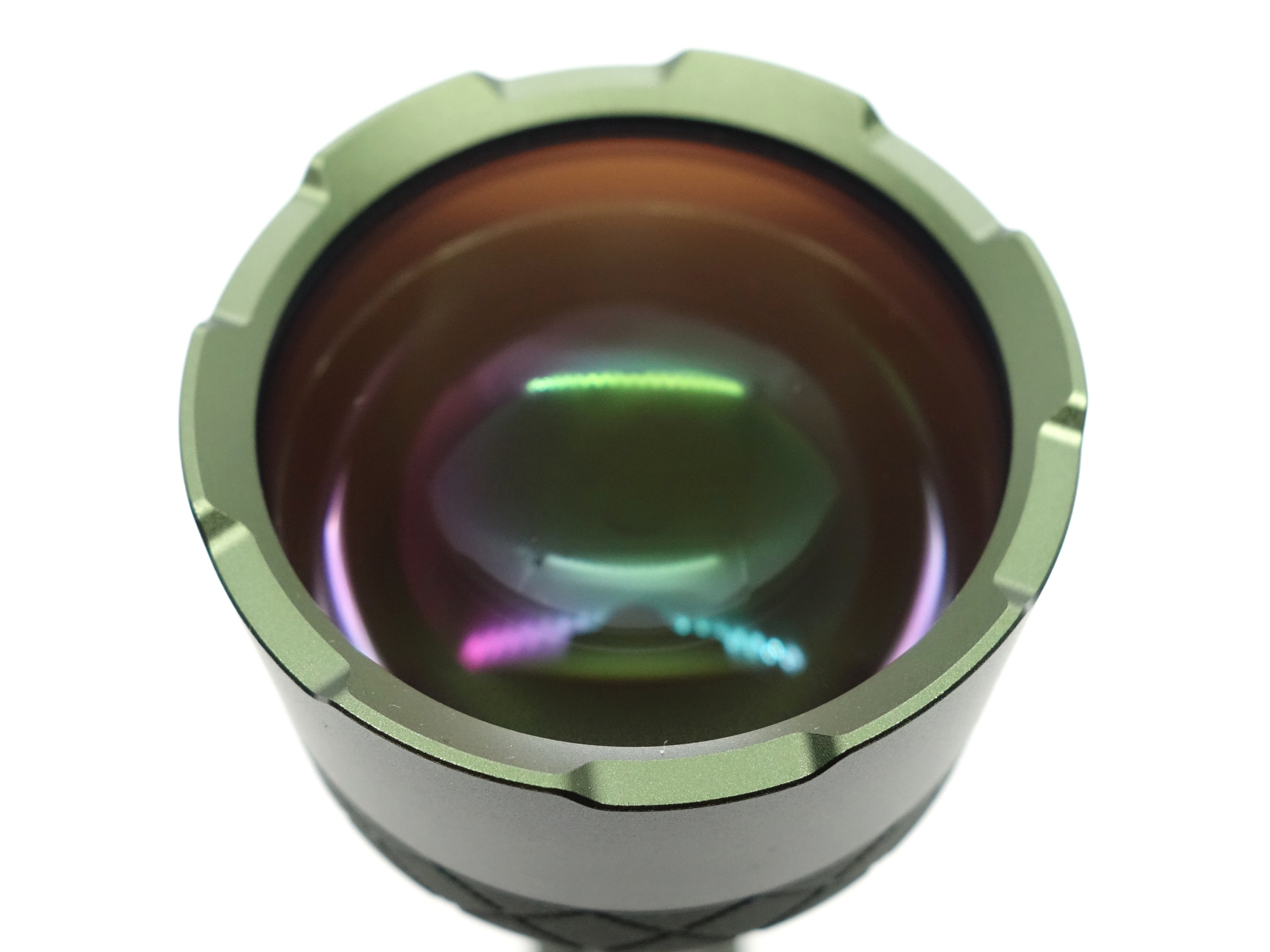
You can find a partial teardown of the head in my review of the NLIGHTD L4 Prototype.
CCT, CRI, and duv#
I have taken Correlated Colour Temperature (CCT) and Colour Rendering Index (CRI, RA of R1-R8) measurements with the torch positioned ten metres away from an Opple Light Master Pro III (G3). I measured the centre of the beam.
The CCT is around 6500K, the CRI is around 65 and the Delta u, v is slightly positive (green) on Low and close to zero on High.
The beam produced has an extremely intense hot spot with minimal spill.
| Mode | CCT (K) | CRI (Ra) | x | y | Duv |
|---|---|---|---|---|---|
| Low | 5921 | 61.2 | 0.3224 | 0.3531 | 0.0105 |
| High | 6895 | 66.1 | 0.3064 | 0.3252 | 0.0045 |
Calculate Duv from CIE 1931 xy coordinates
Dimensions and size comparison#
Dimensions#
I took the following measurements using a digital caliper.
| Measurement | Unit (mm) |
|---|---|
| Length | 164.45 |
| Head diameter | 59.36 |
| Tail diameter | 32 |
| Eight glow stick slots | 13.75 * 2.34 * 2.15 |
Weight#
I took the following measurements using a digital scale.
| Weight | Unit (g) |
|---|---|
| Torch | 289.5 |
| Battery | 73.76 |
| Torch and battery | 363.26 |
Size comparison with its competition#
From left to right: NLIGHTD L4 Green, NLIGHTD L4 Prototype
From left to right: NLIGHTD L4 Green, NLIGHTD L4 Prototype
User interface#
The NLIGHTD L4 has an electronic side switch with a battery status indicator.
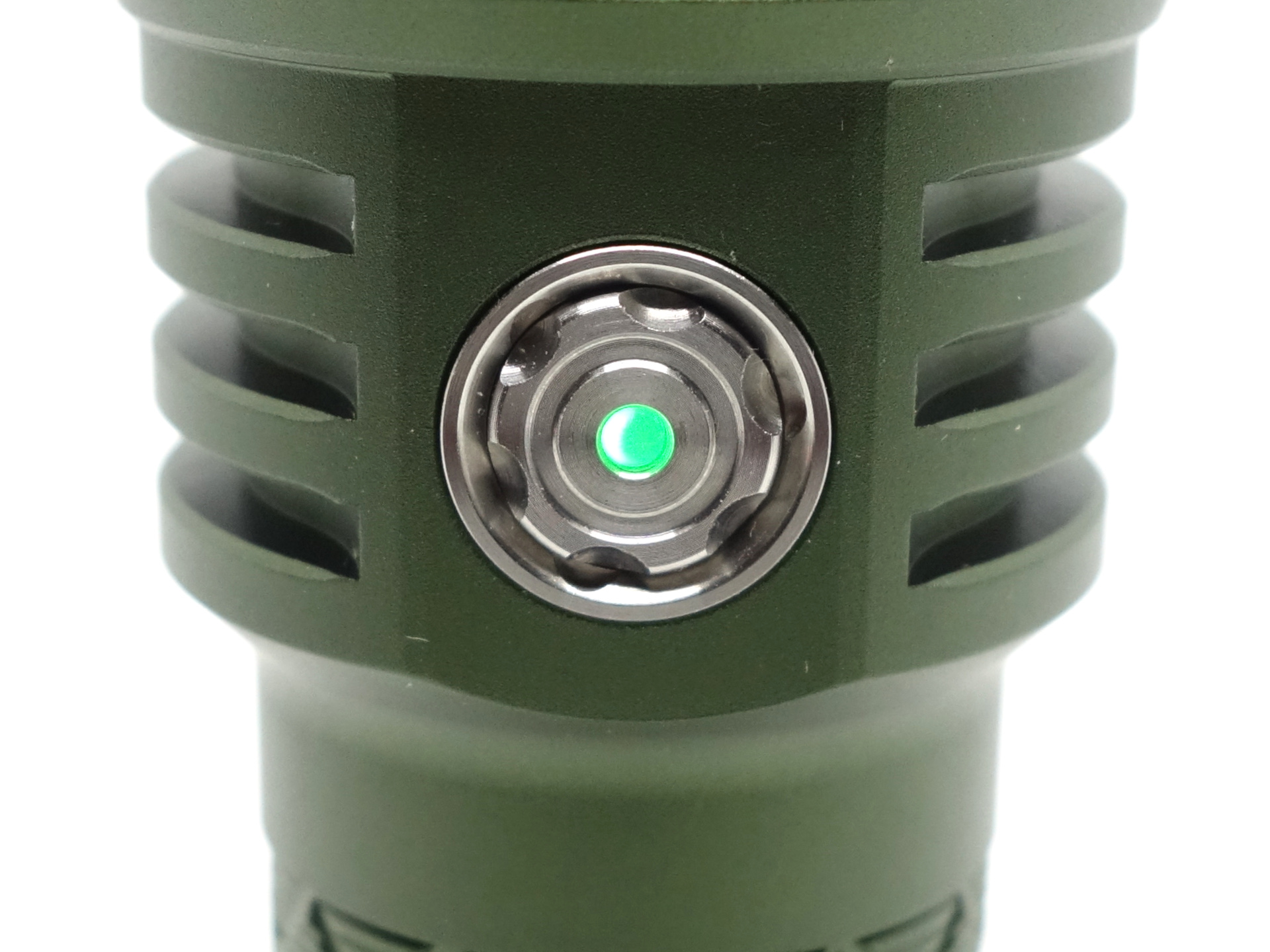
There are two main modes: Low and High.
| State | Action | Result |
|---|---|---|
| Off | Press and hold | Nothing |
| Off | Click | High |
| On | Click | Cycle (High, Low) |
| On | Hold | Off |
| Off | Four clicks | Lock |
| Lock | Press and hold | Momentary Low |
| Lock | Four clicks | Unlock |
Mode memory#
There is no mode memory. The torch defaults to High.
Low voltage protection#
There is low voltage protection. The red battery status light turns on around 3.15V and the torch turns off around 3.03V.
I tested low voltage protection by connecting the driver of the torch to a bench power supply and then by lowering the voltage from 4.2V to 0V.
Pulse Width Modulation#
I did not notice any visible PWM (flickering).
What I like about the UI#
- Simple to use.
- Shortcut to High from off.
What could be improved#
I would personally prefer it if it had “Click” for off and “Press and hold” to cycle through the modes.
A “Press and hold” from off for a moonlight mode would be useful for using this as an EDC torch.
Batteries and charging#
Battery#
The torch came with an NLIGHTD 21700 3.6V Li-ion 6500mAh cell. It arrived with a voltage of 3.5V.
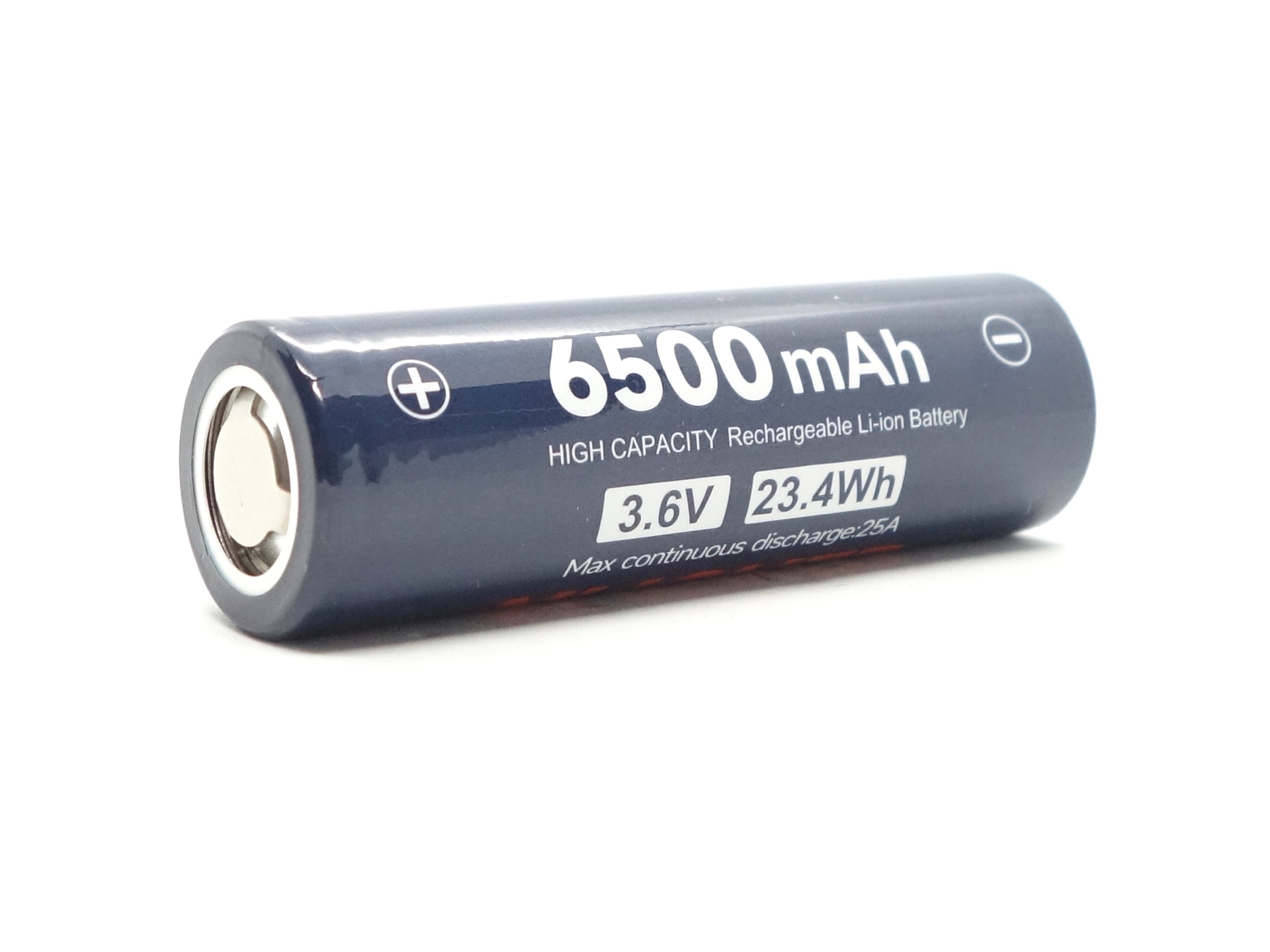
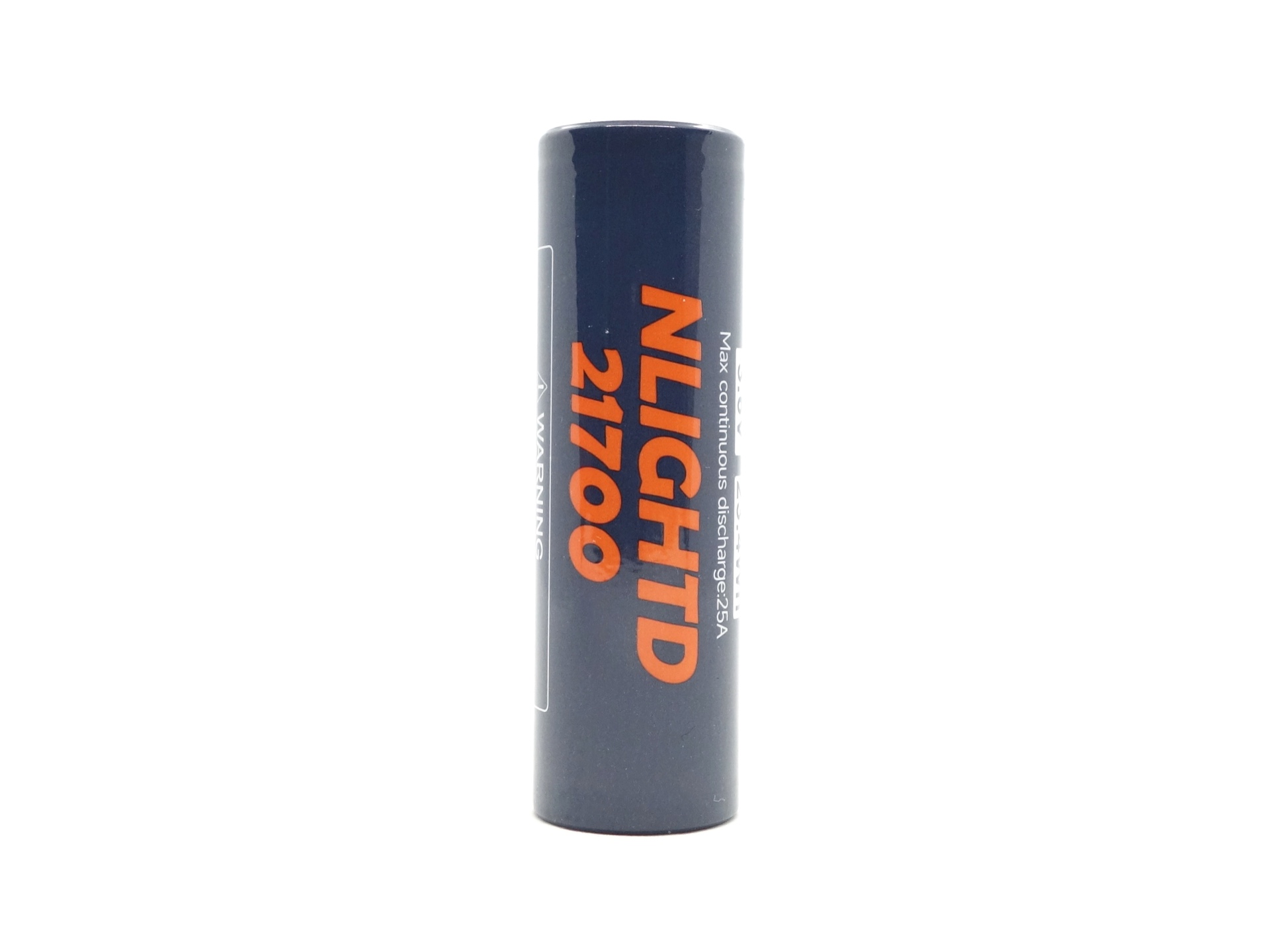
The cell was isolated with a piece of plastic.
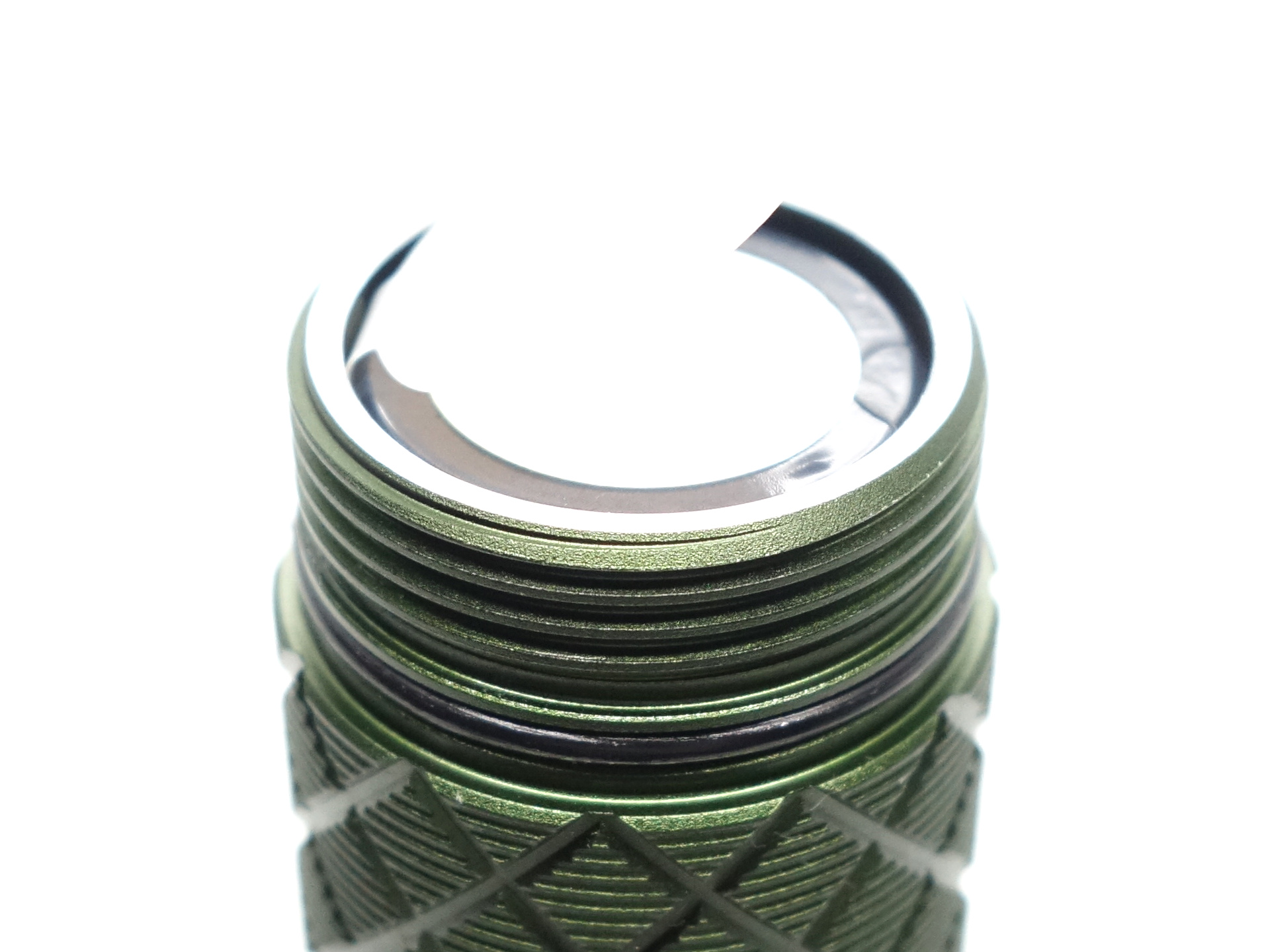
I tried the following cells:
| Cell | Top | Compatible? | Comment |
|---|---|---|---|
| NLIGHTD 21700 3.6V Li-ion 6500mAh | Flat | Yes | |
| Molicel P42A 21700 4200mAh | Flat | Yes | |
| Wuben ABD4800 21700 3.6V Li-ion 4800mAh | Button | No | Too long. |
| Vapcell F56 21700 3.7V Li-ion 5600mAh | Flat | Yes |
Charging#
There is built-in USB-C charging.
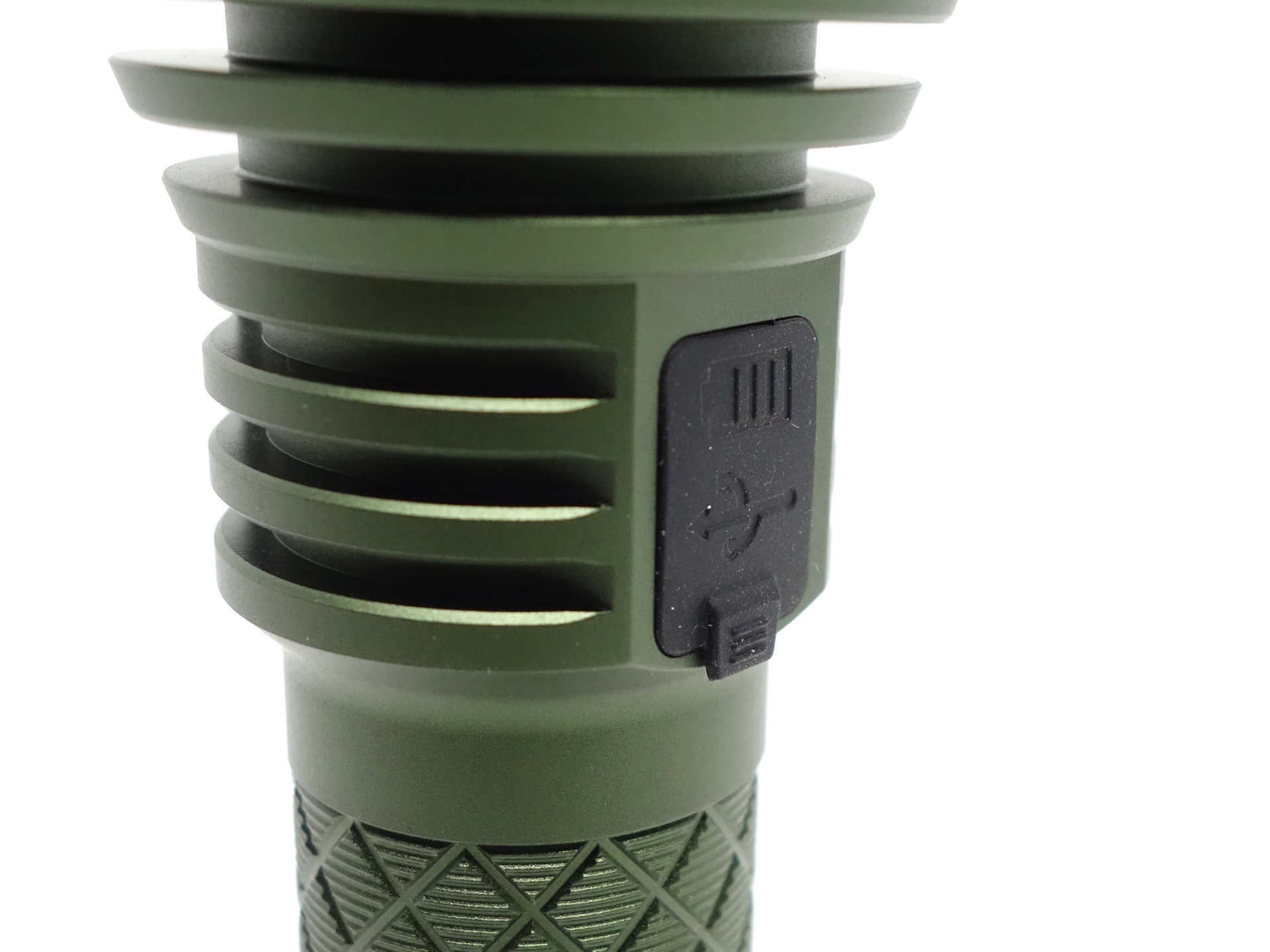
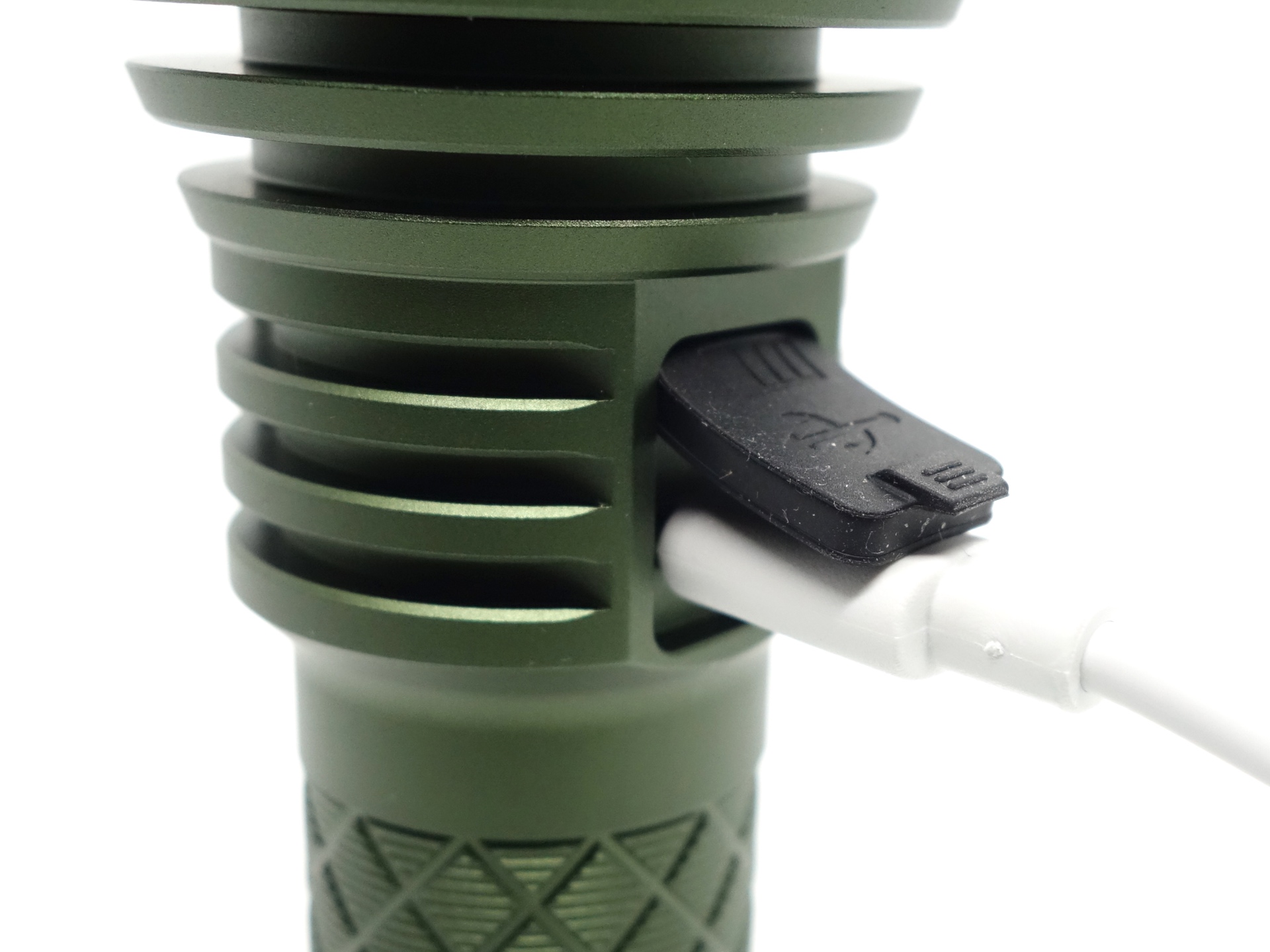
Power supply: PinePower Desktop USB-C
USB Meter: ChargerLAB Power-Z KM003C Amazon Australia
Room temperature: 15 C
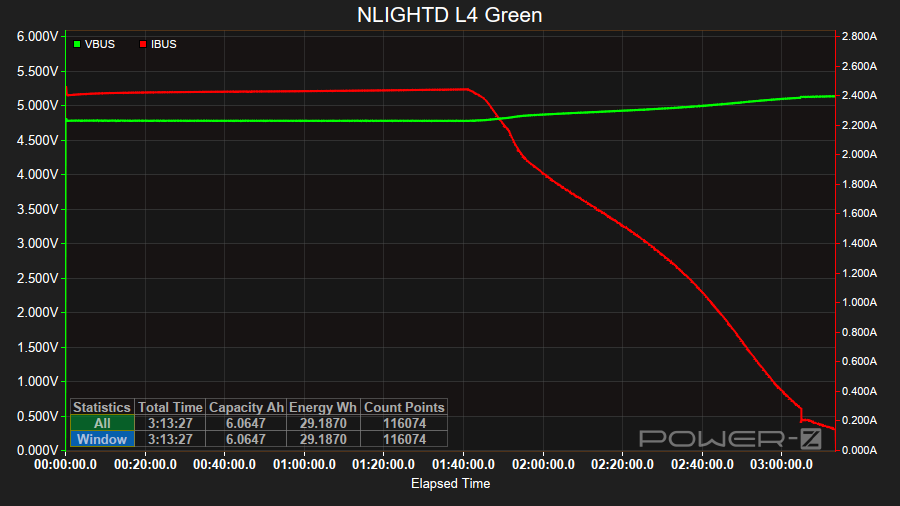
It took 3 hours 13 minutes to charge the battery from 2.94V to 4.20V at a rate of 5V/2.4A.
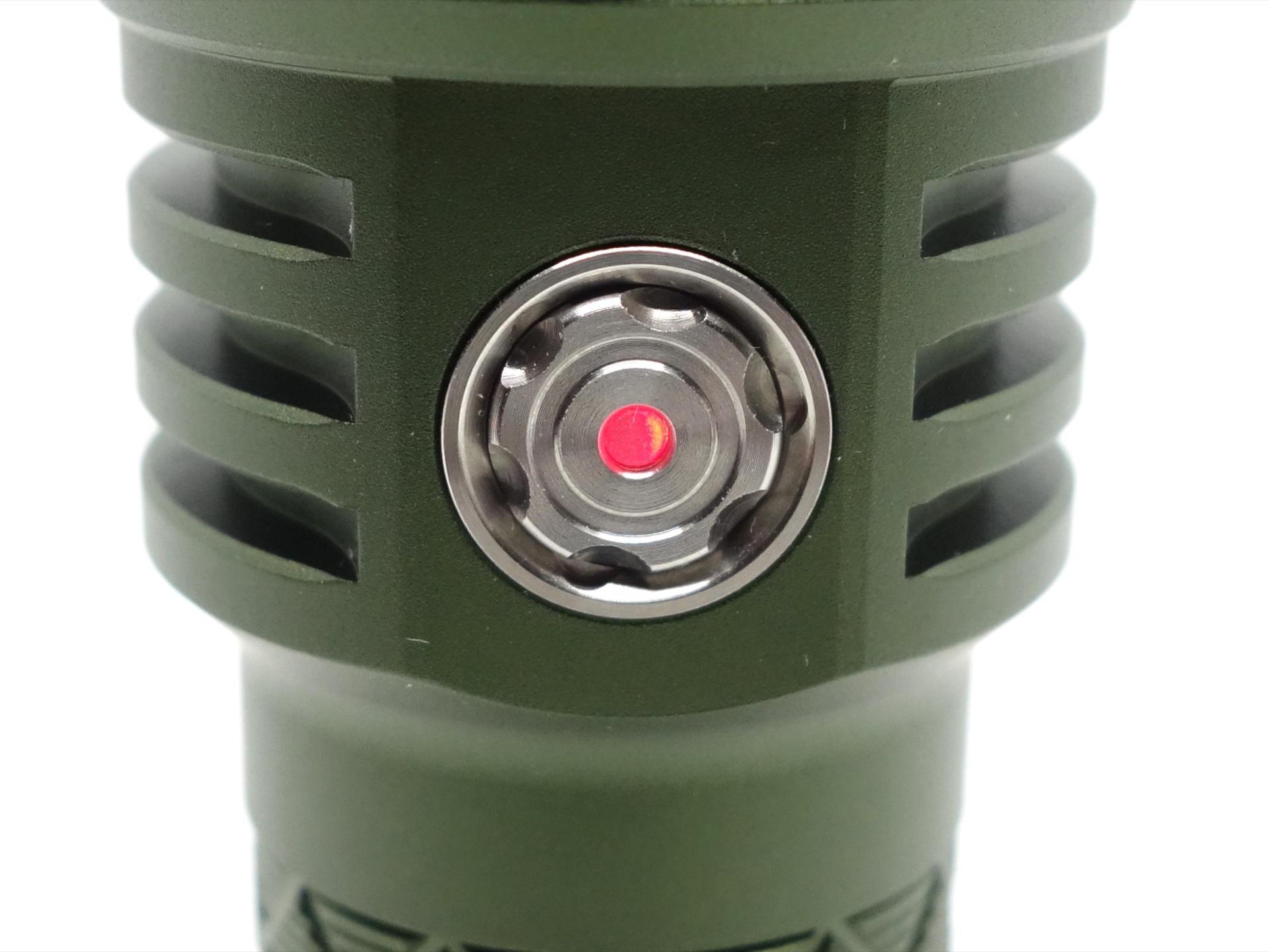
The charging status indicator is red while charging and it becomes green when charging is complete.
Performance#
Specifications from the user manual:
| ANSI/NEMA FL1 | High | Low |
|---|---|---|
| Output (lumens) | 900 | 300 |
| Runtime | 2min + 2h 5min | 2h 45min |
| Beam Distance (metres) | 2,500 | |
| Beam Intensity (cd) | 1,563,000 |
I tested the light using the included flat top NLIGHTD 21700 3.6V Li-ion 6500mAh cell.
Lumen measurements#
I measured the current at turn on with a bench power supply.
| Mode | Amps at start | Specs | Lumens @turn on | Lumens @30 sec | Lumens @10 min |
|---|---|---|---|---|---|
| Low | 1.51 A | 300 | 279 | 279 | 271 |
| High | 4.71 A | 900 | 809 | 767 | 389 |
Standby drain#
I measured a standby current of 187 µA with a Zoyi ZT-706S Oscilloscope Multimeter.
Runtime graphs#
I used my own DIY lumen tube with a TSL2591 sensor and forked bmengineer’s project RuTiTe to record runtimes.
Note: Lumen measurements may be off by 10% with my DIY lumen tube.
The room temperature was approximately 15 C.
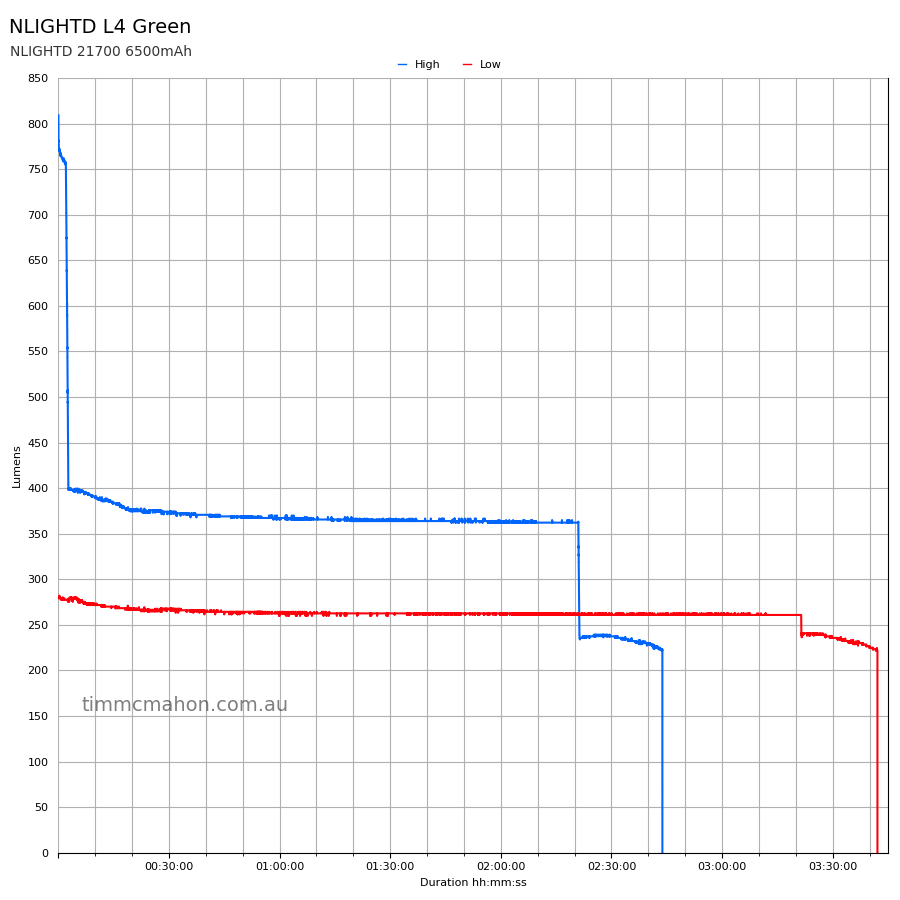
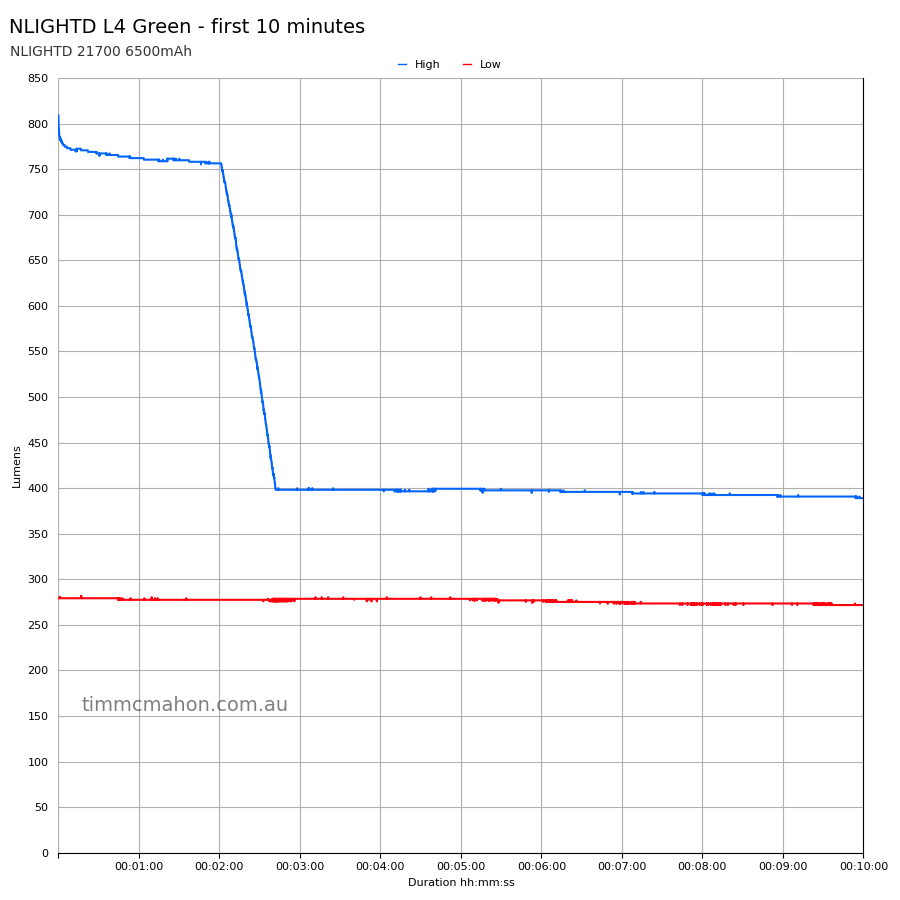
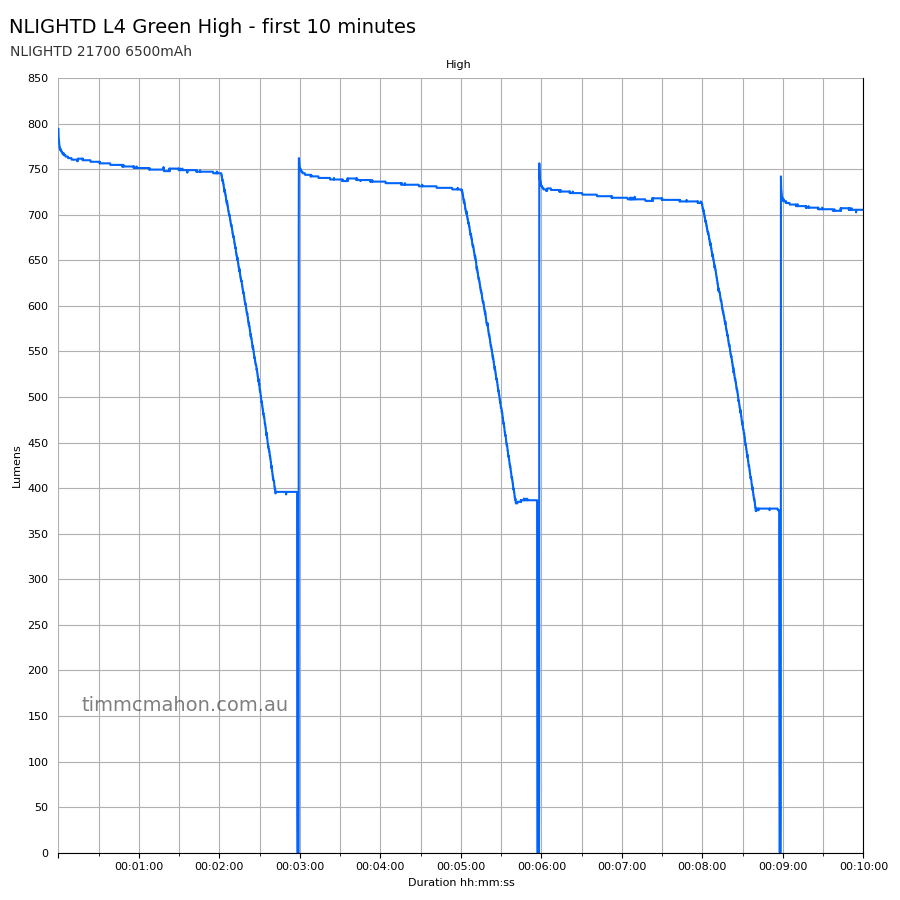
I was able to re-activate High multiple times by turning the torch off and on again every few minutes.
Runtime#
Here is a summary of the runtime results:
| Mode | User manual | Runtime | Turn off | Final voltage |
|---|---|---|---|---|
| High | 2min + 2h 5min | 2h 43min 48s | 2h 43min 48s | 2.97 |
| Low | 2h 45min | 3h 42min 8s | 3h 42min 8s | 2.98 |
“Runtime” is the time until the output reduces to 10% of the output at 30 seconds (as per the ANSI/PLATO FL1 2019 Standard).
“Turn off” is the time until my DIY lumen tube no longer detects more than one lumen.
“+” indicates that the light remained on after recording had stopped.
The runtime is slightly better than expected.
High appears to have a timed step down around 2 minutes 30 seconds. You can restart the timer by turning the light off an on again.
The output is well regulated.
Throw#
I took lux measurements with a UNI-T UT383BT at 30 seconds. Low was measured at 10 metres. High was measured at 20 metres.
| Mode | Specs (cd) | Specs (m) | Candela measured (cd) | Distance (m) |
|---|---|---|---|---|
| Low | 757,900 | 1,741 | ||
| High | 1,563,000 | 2,500 | 1,967,200 | 2,805 |
Beamshots#
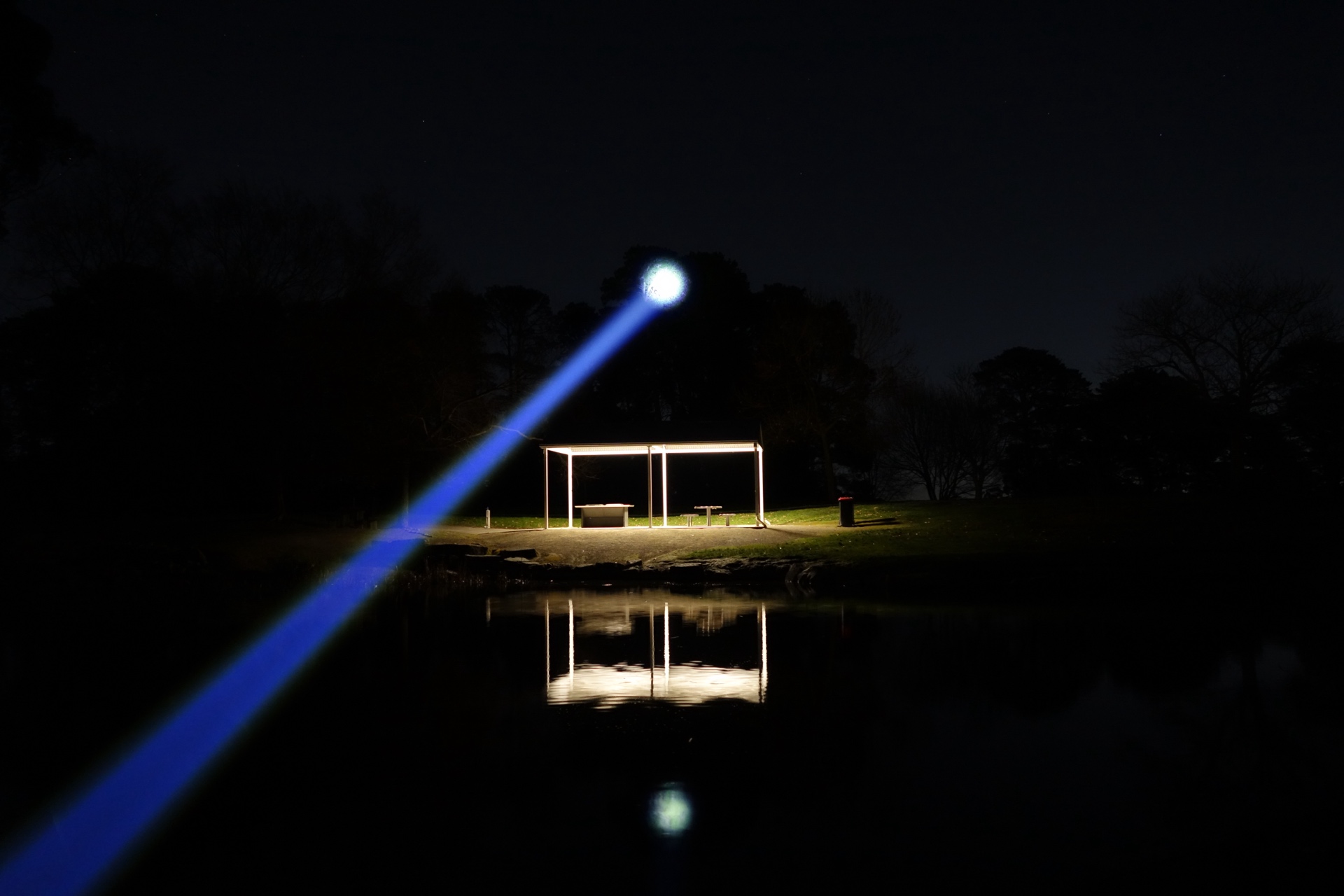
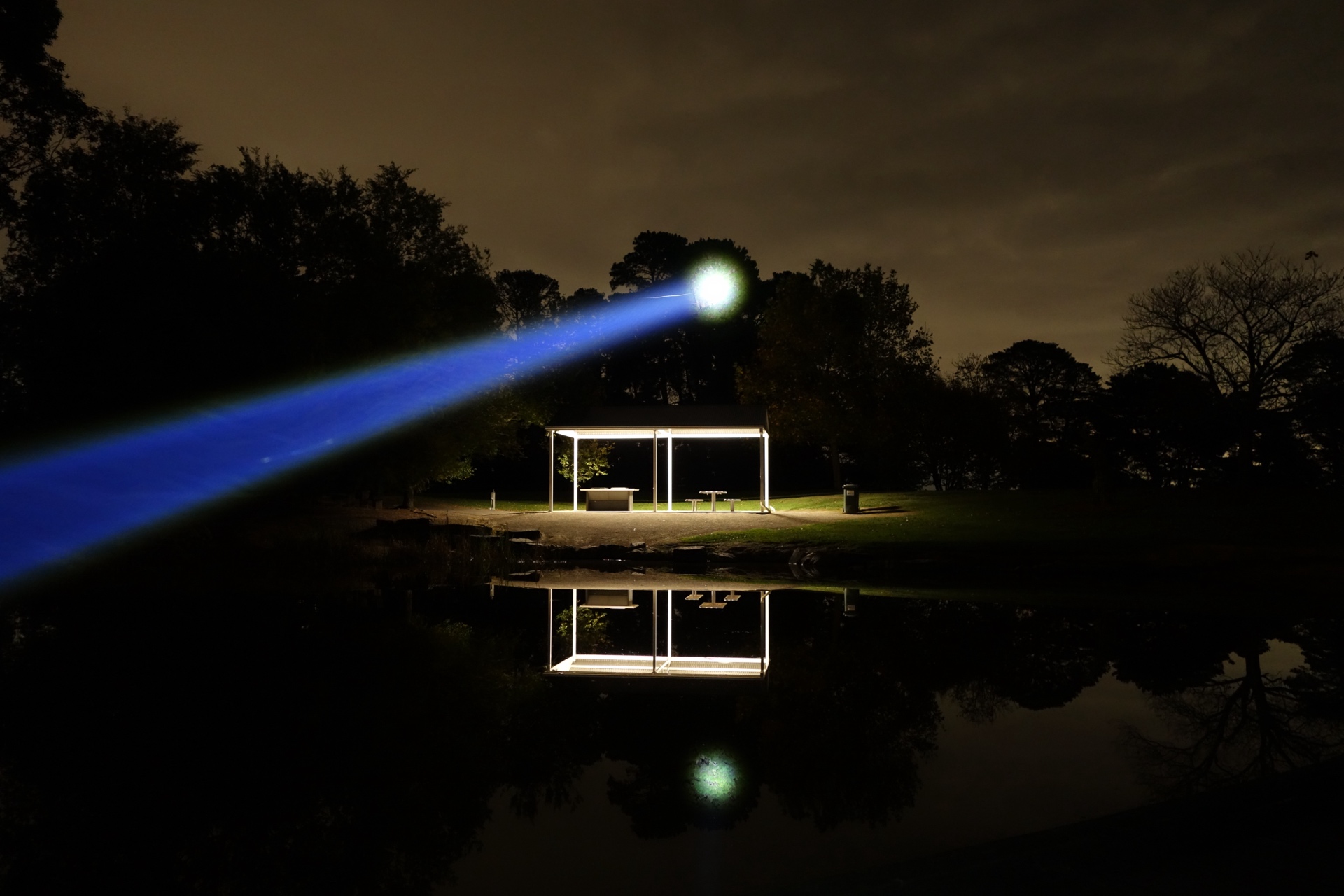
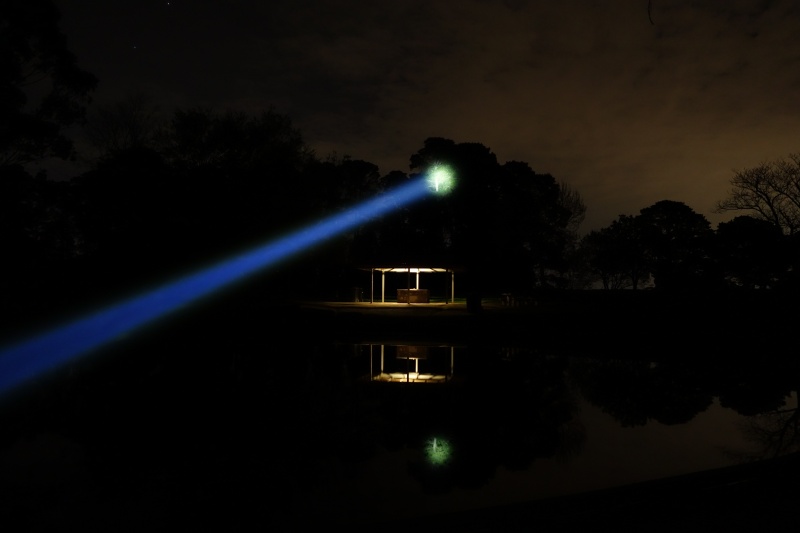
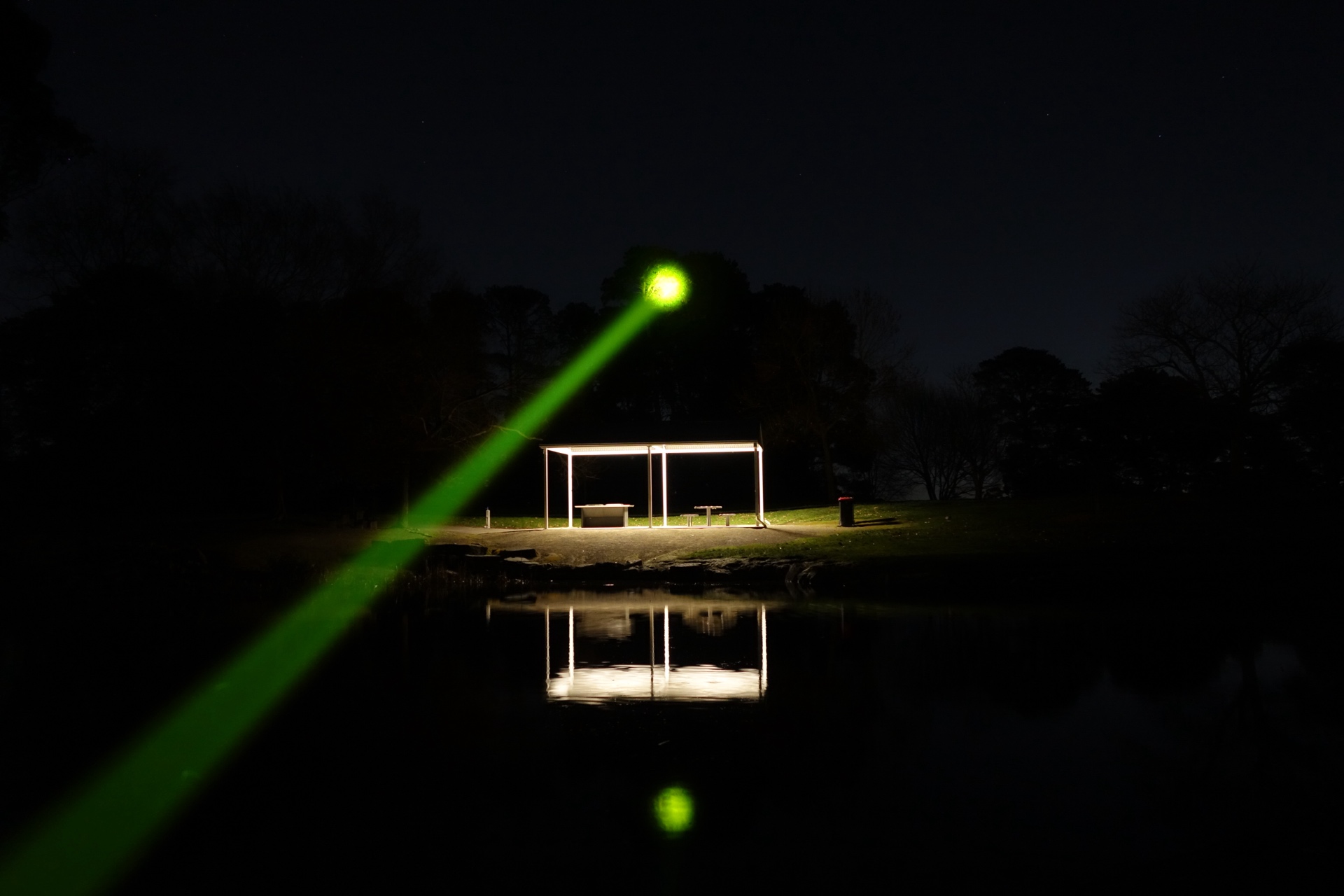
I went to a local park and I aimed the torch at a tree 100 metres away while using High.
Beamshots were taken using a Sony RX100M2 using 1.3", f3.2, ISO 800, 5000K WB.
NLIGHTD L4 Green (High)#
NLIGHTD L4 Prototype (High)#
NLIGHTD L3 (High)#
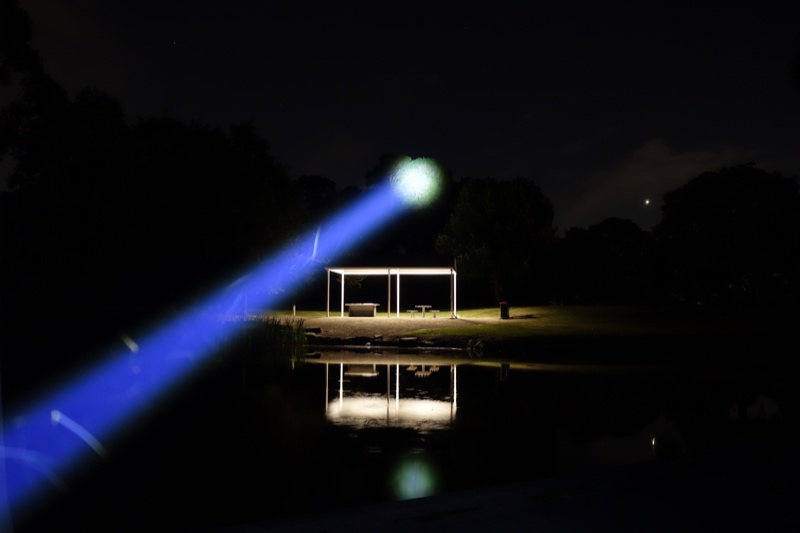
NLIGHTD L2 (High)#
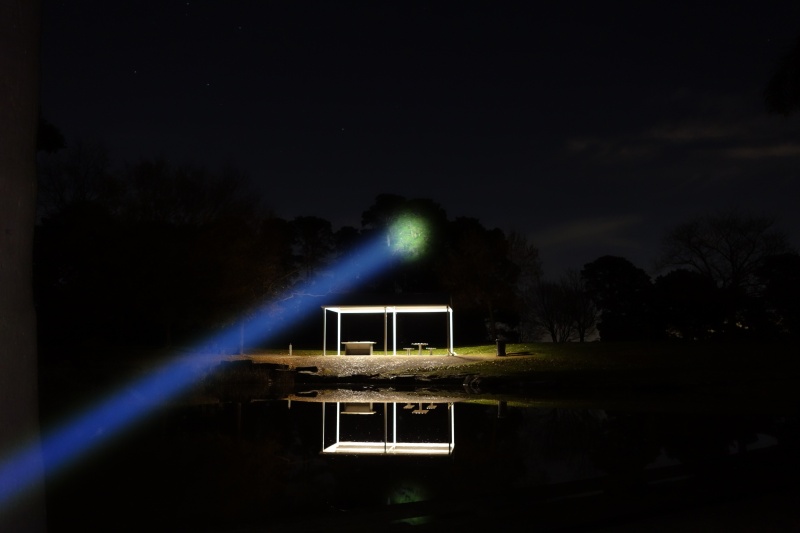
Lumintop Petal (LEP High)#
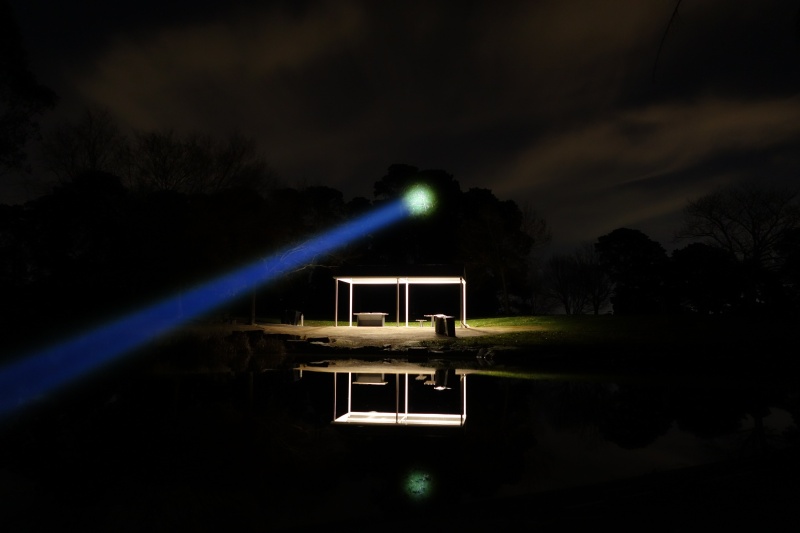
NLIGHTD LZ1 (Turbo) Zoomed In#
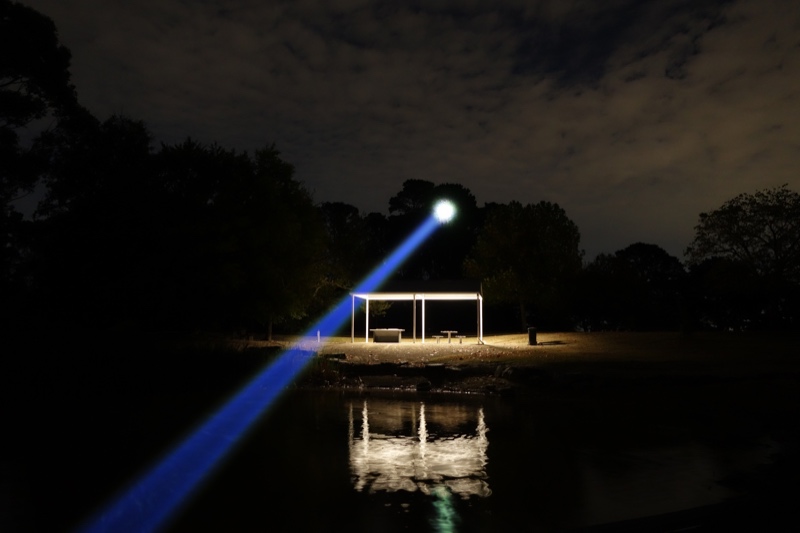
Weltool W4Pro (High)#
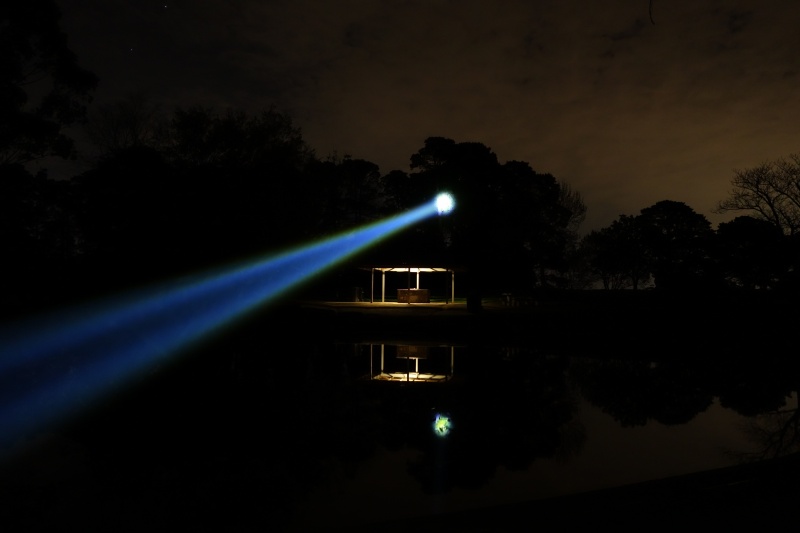
Amutorch BT35 (High)#
NLIGHTD L4 Green (High) Yellow Filter#
The optional yellow filter fits loosely on the head of the torch. It can be flipped open.
Thermal Images#
I used a Thermal Master P3 to take thermal images of the torch while using High. Get 10% off the Thermal Master P3 with code Mcmahon10
Room temperature: 9 C
| Time (mm:ss) | Max Temperature |
|---|---|
| 00:00 | 22.0 C |
| 01:00 | 17.7 C |
| 02:00 | 20.5 C |
| 03:00 | 21.5 C |
| 04:00 | 21.8 C |
| 05:00 | 22.5 C |
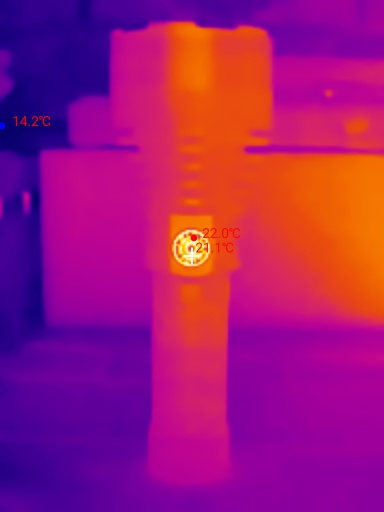
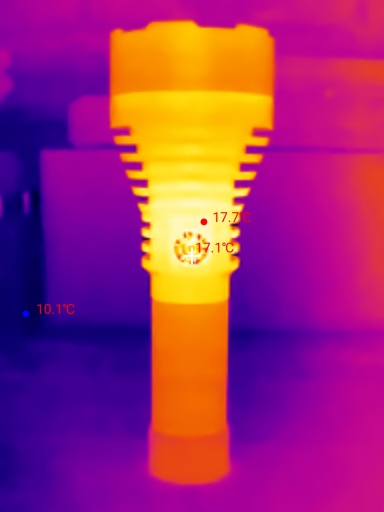
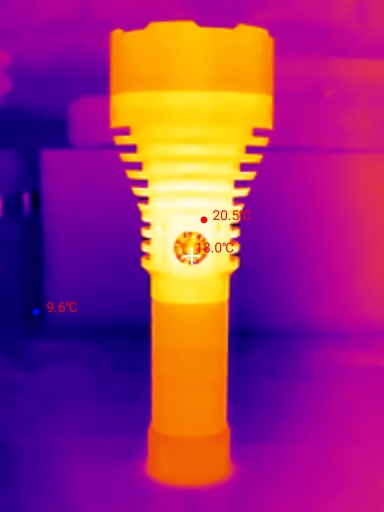
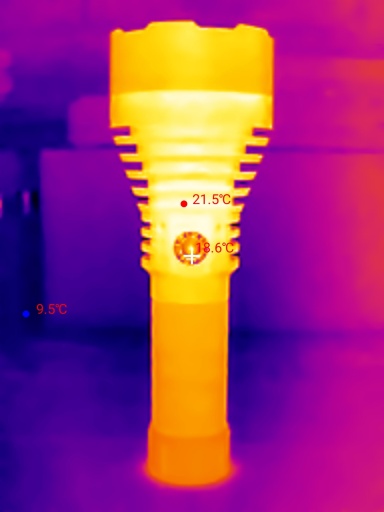
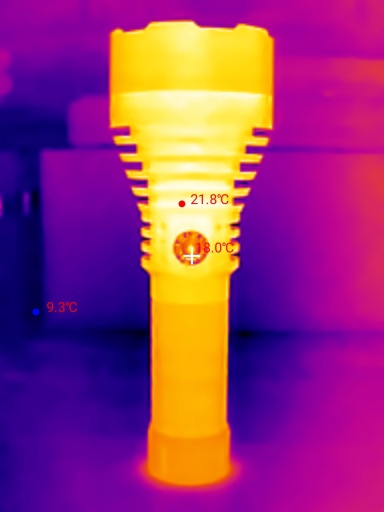
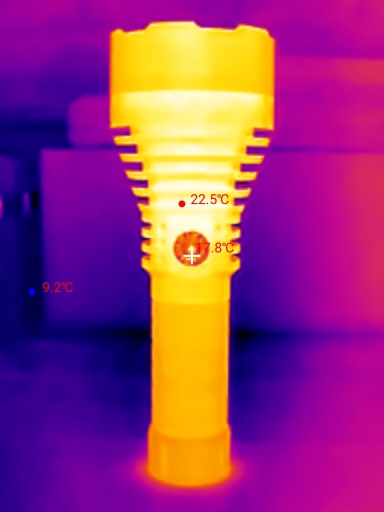
I used a HIKMICRO B20S thermal camera to record the NLIGHTD L4 while re-activating High every few minutes for 12 minutes. The surface temperature reached 40 C while the room temperature was around 9 C. The torch has a 55 C thermal limit where it will step down.
Conclusion#
The NLIGHTD L4 is one of my favourite looking torches from the NLIGHTD range. It looks slightly more elegant than tactical.
In terms of performance, the beam distance is better than expected, the output is well regulated, and the runtimes are good.
I would like to see the 2-3 minute step down timer for High removed because the torch is not getting very hot within the first 10 minutes. The 55 C thermal limit could be relied upon instead to reduce the brightness. The current workaround for High stepping down to a lower output every few minutes is to turn the torch off and on again or change between High, Low and back to High.
We are kind of spoilt for choice these days when it comes to Laser Excited Phosphor torches.
If you do not already have the NLIGHTD L1 then this L4 may be worth getting.
If you are looking for a LEP torch that you can EDC, then I would recommend the NLIGHTD L3 (High) because the beam has a slightly wider hot spot and may be more practical for that use case.
Pros:#
- Excellent build quality.
- Good runtime.
- Good beam distance.
- Nice looking beam.
- Built-in USB-C charging.
Cons:#
- High drops after 2 minutes but it can be re-activated.
- User interface is a bit awkward with “hold for off”.
Price#
The aluminium NLIGHTD L4 is US$155.97 at nealsgadgets.com after using the code NLDL4 (valid 6th to 31st July 2026) for 40% off.
The NLIGHTD L4 is available in black aluminium, green aluminium, silver aluminum, polished titanium and stonewashed titanium.
Product page#
Promo code: TimMcAU
Promo code: TIMMC
NLIGHTD L4 at nealsgadgets.com (affiliate link)
I may earn a commission if you use an affiliate link or a promo code. This will help fund future torch reviews and tutorials.